 Garbamons
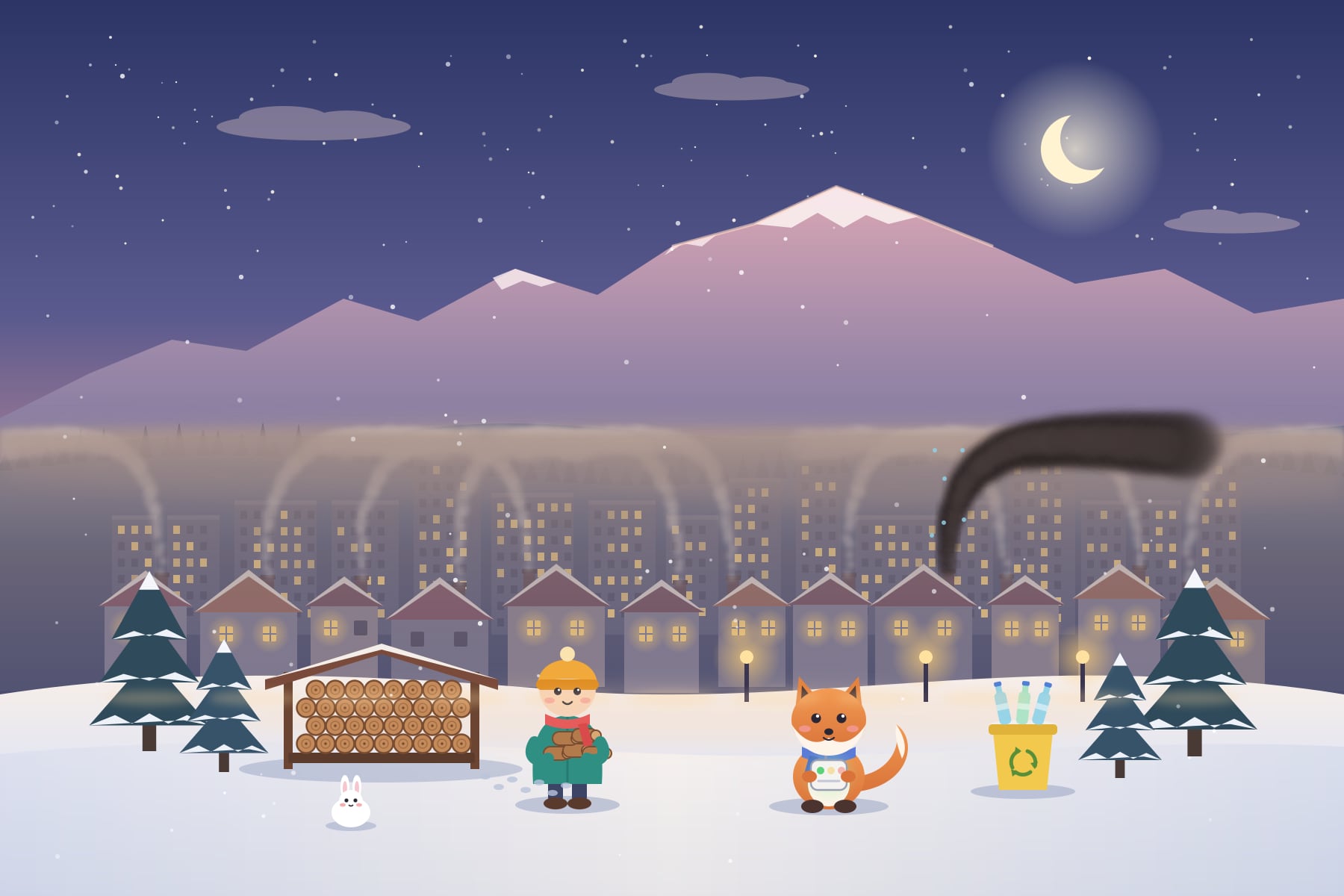
Winter smoke: why burning waste at home hurts everyone, and what the new EU air rules change
Cold, still air traps stove smoke over towns every winter, and rubbish burned at home makes it far more toxic. We explain winter smog with Sofia as the main case, how to spot and report waste burning, and what the revised EU air quality law changes from December 2026.
On a still January evening, Sofia can disappear under its own smoke. The city sits in a basin ringed by mountains, and when cold air settles on the valley floor, every chimney adds to a layer that has nowhere to go. Municipal figures cited by the Institute for European Environmental Policy (IEEP) put the number of Sofia households heating with wood and coal at about 32,000, and link those stoves to 80% of winter days over the particle limits.
What goes into a stove matters as much as how many stoves there are. In laboratory tests, plastic waste burned in a household stove gave off 5 to 40 times more PM10 than dry firewood, and 50 to 750 times more cancer-linked PAHs. Here is why winter air gets so bad, why burning rubbish at home harms a whole street, what Sofia is doing about it, and what the revised EU air quality law, due in national law by 11 December 2026, changes for the people breathing that air.
The short version
- Why winter is worse: cold, still weather traps a lid of air over towns and valleys just as stoves are lit. Heating buildings is Europe's largest source of fine particles.
- Waste is the worst fuel: plastics, painted wood, textiles and tyres release far more particles and toxic compounds than dry wood. Burning them is illegal in Bulgaria.
- Sofia's experiment: a heating low-emission zone bans wood and coal in nine central districts and covers the whole municipality from 1 January 2029, backed by free stove replacements.
- New EU rules: by 2030 the annual limit for PM2.5 falls from 25 to 10 µg/m³ and for PM10 from 40 to 20. Citizens gain stronger rights to go to court and to claim compensation.
- What you can do: burn only dry wood, never waste, check the air index, wear a well-fitted FFP2 mask if you must be out on bad days, and talk to (or report) neighbours who burn rubbish.
Why winter air gets worse
The lid over the valley
Normally, air near the ground is warmest and rises, carrying pollution away. On calm winter nights the ground cools fast and cold air gets trapped under warmer air above. This temperature inversion works like a lid on a pot. In Sofia, according to IEEP, inversions are most common in January and February, and pollution episodes can last one to two weeks. Alpine valleys, Polish towns and Balkan basins know the same pattern. The worst hours are usually evenings, when people come home, light their stoves and the air is at its calmest.
The chimney problem
The European Environment Agency (EEA) found that in 2020 the residential, commercial and institutional sector, mostly heating buildings, produced 58% of Europe's PM2.5 emissions, 44% of PM10 and 85% of benzo(a)pyrene, a carcinogenic PAH. Traffic matters too, especially for nitrogen dioxide, but in winter the chimney is often the main story. In Sofia, the IEEP study cites national data that burning wood and coal accounts for about 42% of PM10.
PM2.5 and PM10 in plain words
Particulate matter (PM) is a mix of tiny particles in the air. PM10 particles are 10 micrometres across or smaller and reach the airways. PM2.5 particles are 2.5 micrometres or smaller, about 30 times thinner than a hair, and get deep into the lungs. The World Health Organization (WHO) says they can even enter the bloodstream. For health, the WHO's 2021 guidelines say PM2.5 should average below 5 µg/m³ over a year and 15 over a day, and PM10 below 15 and 45.
What it does to health
The WHO estimates that outdoor air pollution caused 4.2 million premature deaths worldwide in 2019, mostly from heart disease and stroke, then lung disease, respiratory infections and lung cancer. In the EU, the EEA estimates that 182,000 deaths in 2023 could have been avoided if PM2.5 had met the WHO guideline. That is 57% fewer than in 2005, but about 95% of people in European cities still breathe air above the guideline, and eastern and south-eastern Europe suffer the most. Children, older people, pregnant women and people with asthma, heart or lung disease are the most vulnerable. Studies cited by IEEP put Sofia's health costs from air pollution at around EUR 2.6 billion a year.
Burning waste at home: the worst fuel there is
What comes out of the chimney
Some households burn plastic bottles, packaging, old clothes, furniture or even tyres, to save money or get rid of rubbish. A 2020 study in Atmospheric Chemistry and Physics by Hoffer and colleagues tested 12 common types of household waste in a stove. Fibreboard and other wood-based waste produced about twice the PM10 of firewood. Plastics produced 5 to 40 times more, and 50 to 750 times more PAHs, so the cancer-related toxicity of their smoke was up to 4,100 times higher than wood smoke. In Hungary, the authors note, polls suggested 2 to 10% of people burn waste in stoves regularly. The real scale is unknown anywhere, because the practice is illegal and rarely recorded.
Waste smoke can also carry:
- Dioxins and furans, which form when chlorine-containing materials such as PVC burn badly. The WHO names incomplete burning as a major source. Dioxins build up in the food chain and stay in the body for years, and long-term exposure is linked to harm to the immune and developing nervous systems.
- PAHs, including benzo(a)pyrene, which are carcinogenic and cling to the finest particles.
- Metals and other residues from paints, coatings, inks and treated wood, which end up in smoke and in ash that people often spread in gardens.
A stove is not an incinerator. It cannot reach high, stable temperatures or clean its exhaust, and the smoke comes out at roof height, right where neighbours breathe.
Why it is illegal
In Bulgaria, burning clothes, tyres and waste is banned by law everywhere, not only in low-emission zones, with penalties under Articles 41a and 41b of the Clean Air Act. Many other countries have similar rules. Burning waste also damages stoves and chimneys and raises the risk of chimney fires.
How to recognise it
- an acrid, chemical or burning-plastic smell, quite different from wood smoke;
- thick dark, black or yellowish smoke;
- dense smoke late at night;
- soot flakes on windowsills, washing or snow;
- a pattern that repeats from the same chimney.
How to report it
In Sofia, use the municipality's Call Sofia platform or app, which takes non-urgent reports with a map location and photos and lets you follow the status. The municipality says its inspectors act on citizen reports. The Ministry of Environment and Water's Green Phone also takes complaints, and its published logs show chimney smoke and tyre burning reports being forwarded to Sofia's district administrations under the Clean Air Act. Elsewhere, contact your municipality or the local council's environmental health team.
Be specific: address, dates, times, what you saw and smelled, and a short video if you can take one safely. Repeated, dated reports help inspectors arrive at the right moment. For a fire or immediate danger, call 112.
Sofia's experiment: a low-emission zone for heating
In 2023, Sofia adopted what IEEP calls Europe's first low-emission zone for household heating. It bans solid fuel heating in nine central districts (Sredets, Krasno Selo, Izgrev, Ilinden, Studentski, Oborishte, Vazrazhdane, Lozenets and Triaditsa) where district heating or gas is available. The zone took effect on 1 January 2025, and the municipality's own page also gives 1 December 2025 for the ban, so 2025/26 was the first full heating season under it. From 1 January 2029 it covers all 24 districts.
Free stove replacements
Sofia replaces old stoves with a pellet stove, a heat pump or an air conditioner at no cost to households. The EU LIFE scheme closed on 31 May 2025, while the Environment Programme 2021 to 2027 aims to cover 10,815 homes and takes applications until 31 December 2029 through heaters.sofia.bg.
What the municipality says it has achieved
These are municipal figures, not independent evaluations:
- By December 2025, more than 15,000 solid fuel heaters had been replaced in 11,127 households, avoiding 219 tonnes of particle emissions a year.
- In June 2026, Mayor Vasil Terziev said more than 20,000 stoves had been replaced, average PM10 had fallen by 22% and there were 52% fewer days over the standards than the previous winter.
- In 2025 the city met the annual PM10 limit of 40 µg/m³ for the third year running.
Weather varies a lot between winters, so one season's drop cannot all be credited to policy. Estimates of solid fuel households also differ: about 32,000 in 2022, over 50,000 in a 2024 report. Traffic remains a problem too: a municipal adviser, Ivaylo Hlebarov, has said nitrogen dioxide still exceeds limits on major roads. IEEP's interviews raised fairness questions as well. Replacement budgets are fixed and do not prioritise vulnerable households, clean heating can mean higher bills, and low-income families, older people and suburbs without gas are the most reliant on wood and coal.
Bulgaria and the EU court
On 5 April 2017 the Court of Justice of the EU found that Bulgaria had systematically and continuously exceeded the PM10 limits. In December 2020 the European Commission took the country back to court, noting that some areas still had up to 90 days a year over the daily limit. In March 2023 the court dismissed the request for financial penalties because the Commission had not clearly shown the breach continued. Citizens have used the courts too: in 2021, after a complaint by the Clean Air Group of residents and NGOs, a Sofia court ordered the municipality to act on air quality.
The new EU air rules: what changes and when
Directive (EU) 2024/2881, the revised Ambient Air Quality Directive, was adopted in October 2024. Member states must bring it into national law by 11 December 2026. When this was written, it was not clear whether Bulgaria would meet the deadline. The European Environmental Bureau's transposition tracker follows progress.
Stricter limits by 2030
- PM2.5, yearly average: from 25 to 10 µg/m³, plus a new daily limit of 25 µg/m³, which may be exceeded no more than 18 times a year.
- PM10: the yearly limit falls from 40 to 20 µg/m³, and the daily limit from 50 (allowed 35 times a year) to 45 (allowed 18 times).
- Nitrogen dioxide, yearly average: from 40 to 20 µg/m³.
These are closer to the WHO guidelines, though still looser. The EEA found that in 2024 more than 30% of European monitoring stations recorded particle levels above the 2030 standards. One clause matters for Bulgaria: under Article 18, a country may postpone the deadline for a zone to 1 January 2040 if the cuts can only be achieved by replacing a considerable share of domestic heating systems, provided it adopts an air quality roadmap and meets other conditions.
New rights for citizens
- Going to court: people with a sufficient interest must be able to challenge air quality plans, roadmaps, short-term action plans and the siting of monitoring stations (Article 27).
- Compensation: people whose health is damaged because authorities intentionally or negligently broke the rules on air quality plans and short-term action plans must be able to claim compensation (Article 28). Time limits cannot start before the breach ends and the person knows of the damage. This is a claim against authorities, not neighbours.
- Better information: countries must publish an air quality index with hourly updates, and warn the public quickly when a daily average of 50 µg/m³ for PM2.5 or 90 µg/m³ for PM10 is crossed.
For the first time, EU law says that if authorities negligently fail to fight illegal air pollution and people's health suffers, those people can claim compensation.
New Year's Eve: the dirtiest hour of the year
Germany's Federal Environment Agency (UBA) estimates that fireworks release about 2,050 tonnes of PM10 a year, about 1,700 tonnes of it PM2.5, mostly on New Year's Eve. That is about 1% of the country's annual PM10 in a few hours. Hourly readings after midnight can reach several thousand µg/m³, and in most recent years most German stations exceeded the daily limit on 1 January. After New Year 2021/22, Bulgaria's Ministry of Environment and Water found PM10 over large cities 2 to 3 times higher than the evening before and the morning after. Sofia has chosen a light show for its official celebration, and in 2024 allowed outdoor F2 and F3 fireworks only from 18:00 on 31 December to 02:00 on 1 January. If someone at home has asthma or heart disease, keep windows shut that night.
How to read live air data
- The European Air Quality Index (airindex.eea.europa.eu) shows official stations in six categories, from "good" to "extremely poor", with advice for sensitive groups. It uses hourly data, and its bands were revised in 2025 to reflect the WHO guidelines.
- In Sofia, the municipality points residents to AirSofia.info for current readings.
- aqicn.org (World Air Quality Index project) is an unofficial aggregator of official and citizen sensors. It uses a different scale, so do not compare its numbers with the European index.
- Citizen sensors, such as the AirBG.info network, which passed 1,000 sensors across Bulgaria by 2020, show street-level patterns. Low-cost sensors are less precise, especially in fog, so watch trends rather than single readings.
What you can do
If you heat with wood
- Burn only dry, seasoned wood. The US Environmental Protection Agency recommends moisture below 20%, checked with a cheap moisture meter, and seasoning for at least six months, stored off the ground with only the top covered.
- Never burn household waste, plastic, printed cardboard, painted, treated or glued wood, textiles or tyres.
- Burn small, hot fires with enough air. A stove left smouldering overnight with the air shut makes the most smoke.
- Have the chimney swept and the stove checked before the season.
- In Sofia, check whether you qualify for a free replacement before 2029. Elsewhere, ask your municipality about similar schemes.
On bad air days
- Check the index in the morning and evening.
- Keep windows closed during the evening peak, and air rooms briefly when readings drop.
- Move hard exercise indoors or to midday, especially for children, older people and anyone with asthma or heart disease. Keep asthma medicines to hand.
- If you must be outside for long, only a well-fitted FFP2 (or N95) respirator helps. Health authorities in Victoria, Australia, say these filter about 94 to 95% of fine particles, while cloth and surgical masks do not protect against smoke. Beards break the seal, and respirators are not designed for children.
As a neighbour and a community
- Start with a friendly conversation. Many people do not know how harmful burning waste is, or that free stove replacements exist. Offer facts, not blame.
- If it continues, report it with dates and details. Reports from several households carry more weight.
- Take part in consultations on air quality plans and the new national rules. The right to challenge weak plans is one of the strongest tools the directive gives citizens.
- Clear waste before it ends up in a stove. Dumped furniture, tyres and building waste often get burned. Pin a litter spot on the Garbamons map when you find a dump, and find or start an event to clear it with neighbours.
- Read more articles on clean air and waste, and share what you learn.
Cleaner winters are possible
The basin and the inversions will stay, but the smoke that fills them comes from choices: what is burned, what heating people can afford, and whether rules are enforced. EU deaths from fine particles have more than halved since 2005, and Sofia's first full winter under its heating zone suggests that bans paired with free replacements can change the air quickly. The simplest step is one any household can take tonight: keep rubbish out of the stove.
Facts and figures were checked against the sources below on 14 November 2026. Sofia's results are the municipality's own figures, and many countries were still transposing the new directive when this was written.
Sources and further reading
- EUR-Lex: Directive (EU) 2024/2881 on ambient air quality and cleaner air for Europe
- WHO: Global air quality guidelines (2021)
- WHO: Ambient (outdoor) air pollution fact sheet
- WHO: Dioxins and their effects on human health
- European Environment Agency: Air quality improving, but just over 180,000 deaths still attributable to air pollution in EU
- European Environment Agency: Air quality status in Europe 2026
- European Environment Agency: Sources and emissions of air pollutants in Europe
- European Environment Agency: What do the air quality index values mean?
- European Environment Agency: European Air Quality Index
- Hoffer et al., Atmospheric Chemistry and Physics (2020): emission factors from illegal burning of municipal waste in households
- US EPA Burn Wise: Best wood-burning practices
- Sofia Municipality (Sofia bez emisii): Low-emission zone for household heating
- Sofia Municipality: free replacement of old heating appliances
- IEEP for the Clean Air Fund: Low Emission Zone in the Heating Sector, Sofia case study (2026)
- BTA: Sofia leads region on low-emission zones, Mayor Terziev says (24 June 2026)
- BTA: Sofia meets annual fine particle pollution standard for third consecutive year (5 March 2026)
- BTA: Sofia's low-emission zone should operate year-round, expert says (18 July 2026)
- Novinite: Sofia to enforce complete ban on wood and coal heating by 2029 (7 September 2024)
- BNT: EC again refers Bulgaria to court over poor air quality (3 December 2020)
- ClientEarth: EU court ruling shows blatant enforcement gap of EU air pollution laws (16 March 2023)
- Umweltbundesamt: Feinstaub durch Silvesterfeuerwerk
- Novinite: On New Year's Eve the air in Bulgaria was 2 to 3 times more polluted than normal (7 January 2022)
- Novinite: Sofia Municipality promotes safety with light show over fireworks (27 December 2024)
- Sofia Municipality: Call Sofia platform for non-urgent reports
- Ministry of Environment and Water: Green Phone reports, January 2024
- Better Health Channel (Victoria, Australia): Face masks for environmental hazards
- Sofia Municipality: AirSofia.info
- World Air Quality Index project: Sofia
- Clean Air Fund: Citizen campaign sparks mayoral election debate on air quality in Bulgaria
- European Environmental Bureau: AAQD transposition tracker