 Garbamons
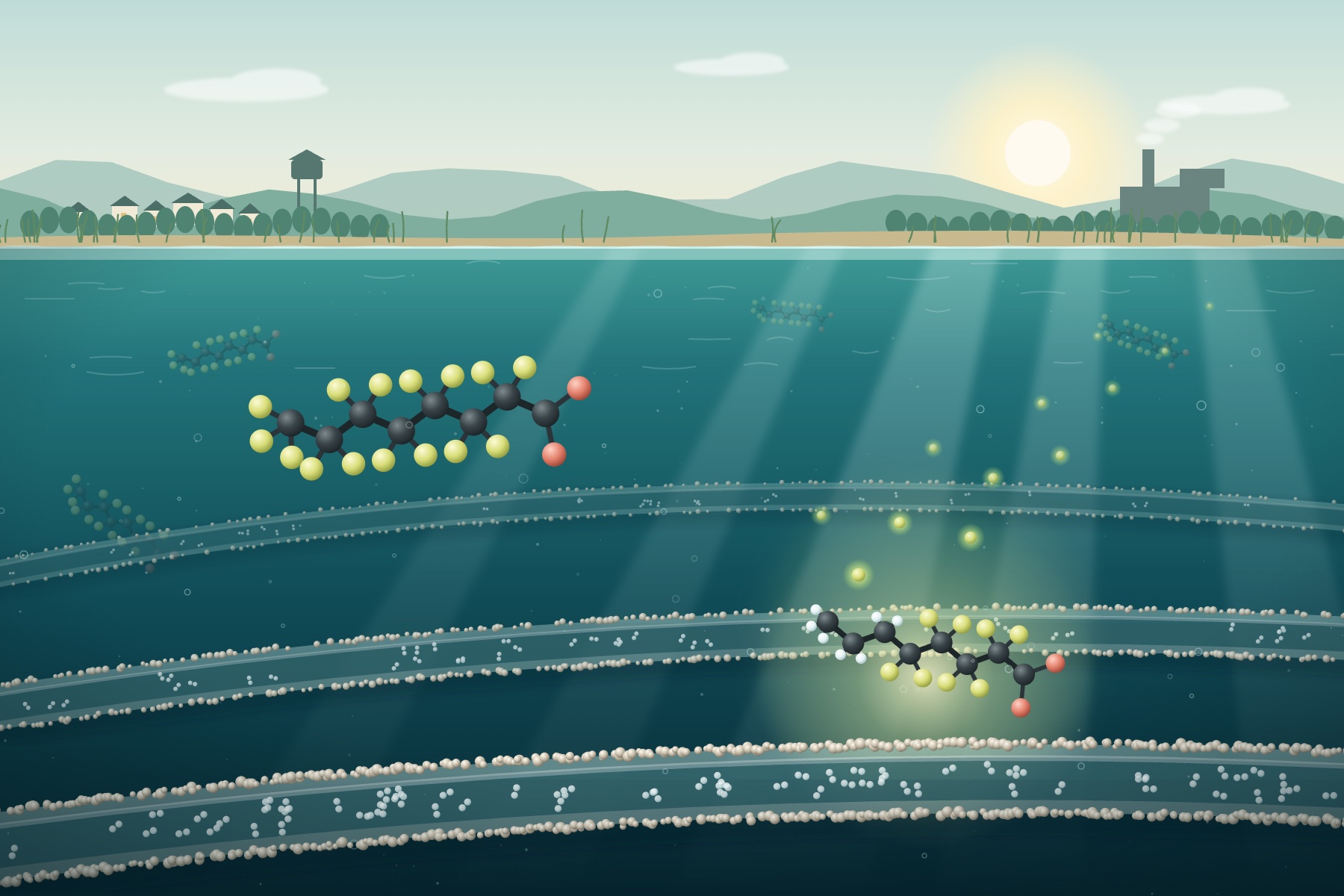
The membrane that breaks forever chemicals: what new PFAS research means for our water, health and planet
A palladium-coated membrane from Arizona State University destroyed six regulated PFAS at room temperature for 58 days. We explain what forever chemicals do to people and nature, why destroying them is so hard, what the study does and does not prove, and how to reduce your exposure today.
Look at the label of a waterproof jacket, a non-stick frying pan or a grease-proof takeaway box and you will rarely find the word PFAS. The chemistry is there all the same, and so is its legacy. These "forever chemicals" now turn up in rainwater, in Arctic wildlife and in the blood of almost everyone who is tested for them. For decades the best we could do was move them around: filter them out of water, then bury, store or burn the filters.
In October 2026 a team led by Bruce Rittmann at Arizona State University, working with Rice University, Tongji University, Nanjing University and the National University of Singapore, published a study in the Proceedings of the National Academy of Sciences describing a different approach. Their palladium-coated membrane captures six regulated PFAS from water and breaks their carbon-fluorine bonds at room temperature. In a 58-day continuous test it removed 93 to 99% of each compound and released 83% of the fluorine they contained as harmless fluoride.
The science channel Two Bit da Vinci explained the study in a recent video. We watched it, read the paper and checked the claims against the wider research. This article covers what PFAS are, what they do to people and the environment, why destroying them is so difficult, what the new membrane achieves and what it does not yet prove, and what you can do today.
The short version
- What they are: PFAS are a family of thousands of human-made chemicals built around carbon-fluorine bonds. They make products non-stick, waterproof and stain-resistant, and they barely break down in nature.
- Why it matters: PFAS build up in people and wildlife. Some are linked to weaker vaccine responses in children, higher cholesterol, lower birth weight and kidney cancer. PFOA is classified as carcinogenic to humans.
- The problem with today's treatment: filters capture PFAS, but the used carbon, resin or concentrated wastewater still contains them.
- The new idea: a palladium catalyst fed with hydrogen from inside hollow fibres strips fluorine from PFAS one atom at a time, at room temperature.
- The catch: it has only been shown in a small laboratory reactor, with acidified synthetic water and high PFAS concentrations. Palladium is expensive, and scaling up is still ahead.
What PFAS are, and why they are everywhere
PFAS stands for per- and polyfluoroalkyl substances. Their backbone is a chain of carbon atoms surrounded largely or entirely by fluorine. The OECD has counted more than 4,700 PFAS-related substances on the market, and the restriction being prepared in the EU covers around 10,000.
The story began in 1938, when a DuPont chemist accidentally made polytetrafluoroethylene, later sold as Teflon. Chemists soon learned that fluorinated chains repel both water and grease, withstand heat and resist almost every chemical attack. Those properties found their way into a long list of products:
- non-stick cookware and some baking paper;
- waterproof and breathable outdoor clothing, tents and shoes;
- stain-resistant carpets, sofas and car seats;
- grease-proof food packaging such as microwave popcorn bags and fast-food wrappers;
- firefighting foams used at airports, military bases and refineries;
- cosmetics, dental floss, ski wax and cleaning products;
- industrial uses in electronics, semiconductors, medical devices, refrigerants and some pesticides.
Many of these uses are convenient. Some, in medicine or safety equipment, are hard to replace. The trouble is what happens after the product has done its job.
The strongest bond in organic chemistry
The bond between carbon and fluorine is the strongest single bond carbon forms in organic chemistry. In a PFAS chain, fluorine atoms overlap around the carbon backbone like plates of armour, leaving almost no gap where a reaction could begin. "There's really no place to get a start to break it down," Rittmann told ASU News.
Sunlight, bacteria and conventional water treatment barely touch these molecules. Some PFAS do change in the environment, but usually only part of the molecule breaks off. The chemical left behind is a shorter fluorinated chain, often just as persistent. Many substances eventually end up as trifluoroacetic acid (TFA), the smallest and most mobile member of the family. Truly destroying PFAS means removing the fluorine. Breaking the chain is not enough.
This is why they are called forever chemicals. What has been released since the 1950s is still circulating in soil, water, air and living things, and the amount keeps growing. When the EU restriction was proposed in 2023, ECHA estimated that around 4.4 million tonnes of PFAS would end up in the environment over the next 30 years unless action was taken.
How PFAS reach our bodies
For most people, exposure comes from several small sources rather than one big one:
- Drinking water, especially near factories that made or used PFAS, airports, military sites and fire-training grounds where foam was used for years, and landfills.
- Food. The European Food Safety Authority has identified fish, eggs and fruit among the main dietary sources in Europe. Grease-proof packaging can transfer PFAS into food.
- House dust from treated carpets, furniture and textiles. This matters most for babies and toddlers who crawl and put their hands in their mouths.
- Work. Firefighters and workers in chemical plants often have far higher levels than the general population.
- Before and after birth. PFAS cross the placenta and pass into breast milk. Health agencies, including ATSDR, still advise that the benefits of breastfeeding outweigh the potential risks.
The video quotes the widely cited figure that PFAS are in the blood of 97% of Americans. The latest estimate is, if anything, higher. Based on US national biomonitoring for 2017 to 2018, the National Academies estimated that 98% of people had a combined PFAS level of at least 2 nanograms per millilitre of blood, and about 9% had at least 20, the level at which it recommends closer medical follow-up.
Once inside the body, the best-known PFAS stay a long time. They bind to proteins in the blood rather than to fat, and the kidneys keep reabsorbing them. In a study of retired fluorochemical workers, half of the PFOA in their blood took about 3.5 years to leave and half of the PFOS about 4.8 years. Even when exposure stops, levels fall slowly.
What PFAS do to people
PFAS have been studied for decades, in factory workers, in communities with contaminated water and in large population surveys. The evidence is strongest for a handful of effects. In 2022 the US National Academies of Sciences, Engineering, and Medicine found sufficient evidence of an association between PFAS exposure and:
- a weaker antibody response to vaccines in children;
- higher cholesterol;
- slightly lower birth weight and foetal growth;
- kidney cancer.
It found limited or suggestive evidence for breast cancer, changes in liver enzymes, high blood pressure in pregnancy (including pre-eclampsia), testicular cancer, thyroid disease and ulcerative colitis.
In November 2023 the International Agency for Research on Cancer (IARC), part of the World Health Organization, classified PFOA as carcinogenic to humans (Group 1) and PFOS as possibly carcinogenic to humans (Group 2B).
In Europe, the European Food Safety Authority set a tolerable weekly intake in 2020 of 4.4 nanograms per kilogram of body weight for the combined total of PFOA, PFOS, PFNA and PFHxS. Its starting point was the immune system. Children with higher PFAS levels produced fewer antibodies after routine vaccinations. EFSA's exposure estimates showed that part of the European population already exceeds this limit.
Two cautions help keep this in proportion. First, most of the evidence links PFAS levels to a higher risk. A blood test cannot say whether a particular person will get ill, or tell them where their PFAS came from. Second, people are exposed to mixtures of many PFAS at once, and most of the thousands of compounds on the market have barely been studied. A lack of data on a newer substance does not show that it is safe.
What PFAS do to the planet
In rain, rivers and seas
PFAS move with water and air. In 2022, researchers at Stockholm University reported that PFOA levels in rainwater around the world, even on the remote Tibetan Plateau, often exceed the strict US health advisory values for drinking water. They concluded that PFAS pollution has crossed a "planetary boundary": the whole planet is now contaminated beyond what we consider safe, and the pollution cannot easily be reversed. Sea spray carries PFAS from the ocean back onto land, so the cycle continues even where no one uses them.
In soil and on farms
Household and industrial wastewater carries PFAS to treatment plants, which cannot remove them. Many end up in sewage sludge, which for decades was spread on fields as fertiliser. In the US state of Maine, PFAS from sludge were found in the soil, water, milk and crops of dozens of farms, and some farmers lost their livelihoods. In 2022 Maine became the first state to ban spreading sewage sludge on land.
In wildlife
PFAS accumulate up the food chain. Some of the highest concentrations in wildlife are found in top predators such as polar bears, seals, otters and seabirds. A 2024 review of Arctic research found PFAS-linked hormonal, immune and reproductive effects in polar bears and Arctic seabirds that are broadly similar to those seen in humans. Fish near contaminated sites can carry enough PFAS that authorities advise anglers to limit how much they eat.
In Europe's backyard
The Forever Pollution Project, a cross-border investigation coordinated by Le Monde, has mapped nearly 23,000 sites across Europe where PFAS contamination has been measured, and another 21,500 where it is presumed because of past activity. Some have become well known:
- In Italy's Veneto region, PFAS from the Miteni plant reached water supplies used by hundreds of thousands of people. In June 2025, a court in Vicenza convicted 11 former managers of the company and its owners, with prison sentences totalling 141 years. It was the first criminal conviction of its kind for PFAS pollution.
- In the Netherlands, residents near the Chemours plant in Dordrecht have taken the company to court. In Belgium, about 1,400 residents living near the 3M plant in Zwijndrecht sued the company in a civil trial that opened in Antwerp in February 2026.
The newest concern is TFA. In 2025 the NGO PAN Europe tested 49 wines. In recent vintages it found a median of 110 micrograms of TFA per litre, while bottles from before 1988 contained none. That was a small study, and the wine industry has disputed it. The trend matches wider monitoring that shows TFA rising in European waters, where standard treatment does not remove it.
The bill
Cleaning up is expensive. The journalists behind the Forever Lobbying Project, working with 18 experts, estimated that cleaning up PFAS in Europe could cost around €100 billion a year, or about €2 trillion over 20 years, if emissions continue. It is a scenario, not a forecast, but it shows the scale. In the United States, 3M agreed in 2023 to pay drinking-water utilities up to $10.3 billion (in present value) over 13 years, and DuPont, Chemours and Corteva agreed to pay $1.185 billion. 3M says it stopped manufacturing PFAS at the end of 2025.
Catching PFAS is not the same as getting rid of them
We already know how to get PFAS out of drinking water. Granular activated carbon, ion-exchange resins and reverse osmosis can all remove them effectively. Each of them separates PFAS from water rather than destroying them. The study's authors make the same point: these technologies sequester PFAS rather than destroy them.
The video compares this to emptying a vacuum cleaner. The floor is clean, but the dust is still in the bag. The PFAS end up in used carbon, spent resin or a concentrated, salty liquid left over from reverse osmosis, and that waste has to go somewhere.
The US Environmental Protection Agency's interim guidance on disposing of PFAS, first issued in 2020 and updated in April 2024 and again in 2026, covers three main routes: deep underground injection wells, hazardous-waste landfills and thermal treatment. It recommends prioritising the options with the lowest potential for release. None is a perfect answer:
- Landfills store PFAS rather than destroy them. Rainwater that seeps through a landfill becomes leachate, which carries PFAS out. It is often sent to a wastewater plant that cannot remove them, so the PFAS return to rivers and sludge.
- Burning can destroy PFAS, but only at very high temperatures held long enough. Otherwise smaller fluorinated fragments can escape into the air. Open fires and backyard burning come nowhere near these conditions.
- Injection wells are only possible where the geology allows, and they also store PFAS rather than destroy them.
The goal is to break the molecule completely and release its fluorine as ordinary fluoride, the same ion found in toothpaste and many mineral waters. The fluoride can then be removed or tolerated at normal concentrations.
Today's destruction methods: brute force
Most methods that destroy PFAS today overpower the carbon-fluorine bond with heat, pressure or aggressive oxidising chemistry:
- Supercritical water oxidation. Water heated above 374 °C and compressed above about 221 bar (around 3,200 psi) behaves like neither a liquid nor a gas, and oxidises organic compounds very effectively. Revive Environmental, a company launched by Battelle, markets this as the "PFAS Annihilator" and reports more than 99.99% destruction of total PFAS. These are company figures, and the reactors need special materials to resist corrosion.
- Hydrothermal alkaline treatment. The start-up Aquagga uses hot, pressurised, strongly alkaline water. In a demonstration funded by the US Department of Defense at a site in North Carolina, it treated about 3,000 gallons (about 11,000 litres) of PFAS-laden liquid in three weeks. Results were still being analysed at the end of 2025.
- Electrochemical oxidation. Companies such as Aclarity use electrodes to oxidise PFAS at normal temperature and pressure. This needs electricity and suitable electrode materials.
- Plasma, ultrasound and ultraviolet-based methods are also being developed.
These approaches are progressing, and several are already in commercial use. They tend to need a lot of energy, durable equipment or careful control of by-products. A gentler route that worked in ordinary conditions would be a useful addition.
How the new membrane works
Hydrogen instead of fire
Burning, supercritical water and electrochemical methods all oxidise PFAS, tearing the molecule apart. The Arizona team went the other way. Their method, hydrodefluorination, is a reduction: it swaps each fluorine atom for a hydrogen atom, one at a time, until the chain has no fluorine left. The paper calls this route comparatively mild.
Hydrogen gas on its own is far too stable to do this. The researchers showed it with a control experiment: when hydrogen flowed through a membrane without a catalyst, PFOA levels did not measurably fall and no fluoride was released.
Palladium as the matchmaker
The catalyst is palladium, a precious metal also used in car catalytic converters. A palladium surface splits hydrogen molecules into single, highly reactive hydrogen atoms. PFAS molecules from the water stick to the same surface. Rittmann put it simply: "The palladium attracts the PFAS molecule, and the palladium attracts the hydrogen and puts them together."
Feeding hydrogen from the inside
The engineering challenge is to bring reactive hydrogen and PFAS to the same spot on the palladium at the same time, and keep that going for weeks. The team used a bundle of hollow polymer fibres inside a small reactor. Hydrogen is pumped into the fibres at a modest pressure (20 psi above atmospheric pressure) and diffuses out through their walls. A film of palladium nanoparticles, just 0.9 grams per square metre, coats the outside of each fibre. The hydrogen reaches the catalyst from underneath while contaminated water flows past on the outside. No gas is bubbled through the water and nothing is heated.
The delivery method makes a real difference. In a comparison test, the team supplied the hydrogen to the gas space above the water instead. PFOA disappeared at about the same rate, but fluoride was released only half as fast. Feeding hydrogen through the fibres doubled the rate of destruction without changing how quickly PFAS were captured.
Two kinds of hydrogen, two jobs
The paper's most interesting finding explains why this works. Palladium absorbs hydrogen into its crystal structure, forming palladium hydride. As it does, the metal swells, and the team measured the spacing between palladium atoms growing by about 4%. They found that hydrogen does two separate jobs:
- hydrogen on the surface helps PFAS molecules attach and lie flat on the metal, ready to react;
- hydrogen stored inside the metal supplies the push needed for each fluorine swap.
The team's computer modelling suggests that the stored hydrogen makes the first fluorine swap much easier, even for GenX, the most stubborn of the six chemicals. The video describes the film as a sponge soaked with hydrogen under a sticky skin. The authors call it a previously unrecognised "dual-hydrogen mechanism" and believe it applies to all six PFAS they tested. "It's a universal mechanism," Rittmann said.
The results: removal and destruction are different numbers
Many PFAS headlines mix up two measurements. Removal means a chemical is no longer in the water. Destruction, or defluorination, means its fluorine has actually come off as fluoride. A material can remove PFAS simply by holding on to them, and the study's controls show how far apart the two numbers can be:
- Palladium without hydrogen removed about 30% of the PFOA but released no detectable fluoride. The chemical had simply stuck to the metal.
- Commercial palladium on carbon, the kind laboratories buy from chemical suppliers, removed about 85% of the PFOA but defluorinated only 37%.
Then came the long test behind the headline numbers. For 58 days of uninterrupted operation, the reactor treated water containing six PFAS that regulators watch closely. Each was present at 50 micrograms per litre. Average removal for each compound over the whole run was:
- PFHxS: 99%
- PFNA: 98%
- PFOS: 97%
- PFOA: 95%
- PFBS: 94%
- GenX (HFPO-DA): 93%
The most important number is the fluoride. The fluoride released corresponded to 83% of the fluorine in the PFAS the membrane removed. This shows that most of the captured PFAS were genuinely broken down, not just stored on the membrane. Longer-chain PFAS broke down faster than shorter ones, and GenX, a replacement for PFOA, was the most resistant.
This builds on the group's earlier work. In 2021 the same team showed that palladium nanoparticles could adsorb PFOA and partly defluorinate it in a hydrogen-based membrane reactor. The 2026 study adds six PFAS treated at once, a two-month continuous run and an explanation of why the process works.
Reality check: from a laboratory bench to your tap
The study is careful and promising. It is also a laboratory result. Several questions remain before anything like it treats real water at scale.
The price of palladium
"Palladium is expensive," Rittmann acknowledged. "It's around $50,000 a kilogram." Reducing the amount needed is one of the group's research priorities. The paper also reports something the press release left out: over the 58 days, the membrane lost about 10% of its palladium.
That sounds alarming, but the amounts are small. The video does a back-of-the-envelope calculation that we checked:
- At 0.9 grams per square metre and $50 per gram, the coating costs about $45 per square metre of membrane. At late-October 2026 market prices of roughly $31,000 to $32,000 per kilogram, it is closer to $28.
- Losing 10% over 58 days costs about $3 to $4.50 per square metre.
- If the loss continued at that rate, roughly half the palladium would be gone after a year, costing about $14 to $22 per square metre per year.
That is manageable for a technology that destroys forever chemicals. The real cost depends on how much membrane area a full-size plant needs. The paper does not give enough detail to work that out, and the long-term durability of the coating still has to be shown. There is also a question to monitor: where does the lost palladium go? Any full-scale system would need to check that metal does not end up in the treated water.
Laboratory water is not river water
- Acidity. Every test ran at pH 4, about a thousand times more acidic than neutral water. Most natural and drinking water sits between about 6.5 and 8.5.
- Concentration. 50 micrograms per litre of each PFAS is about 12,500 times the US drinking-water limit for PFOA and PFOS of 4 nanograms per litre. Higher concentrations make reactions easier to run and measure.
- Clean water. The test water was synthetic. The only interference checks were nitrate and glucose, which did not clearly reduce PFOA removal. Real water contains natural organic matter, salts, minerals and other pollutants that can coat or compete for the catalyst.
Size
The laboratory reactor held 40 millilitres of water, and the water stayed inside for an average of 12 hours. Keeping those 12 hours while treating 1,000 litres a day would need a reactor holding around 500 litres. A city water plant treats millions of litres a day.
That is why the most realistic first use is not your tap. The researchers suggest pairing the membrane with existing treatment. Conventional filters or reverse osmosis would concentrate PFAS into a small stream, and the membrane would destroy them there. Candidate streams include reverse-osmosis brine, liquid used to regenerate ion-exchange resins, landfill leachate and rinse water from firefighting-foam systems. These are exactly the waste streams that currently end up in landfills or incinerators.
What is left over
83% defluorination is impressive, but the other 17% of the fluorine was not released as fluoride. It stayed in partly defluorinated molecules or on the membrane. Any full-scale system would need to show what those leftovers are and how they behave. The team is also developing hybrid versions that combine palladium nanoparticles with bacteria that can break down contaminants.
The rules are tightening, unevenly
Whether anyone builds this technology at scale depends partly on regulation. If utilities and industry must destroy PFAS rather than store them, technologies like this become worth paying for.
United States
In April 2024 the EPA set the first national drinking-water limits for PFAS: 4 parts per trillion (nanograms per litre) for PFOA and PFOS, 10 for PFHxS, PFNA and GenX, and a combined limit for mixtures. Utilities were to finish initial monitoring by 2027 and meet the limits by 2029. In May 2026 the EPA proposed keeping the PFOA and PFOS limits while allowing water systems to request two more years, to 2031, and rescinding the limits for the other four. Those proposals were still pending at the time of writing.
Several states are going further. Minnesota (under "Amara's Law") and Maine already ban PFAS in some product categories and will ban the sale of products with intentionally added PFAS from 2032, unless a use is judged currently unavoidable. Many states restrict PFAS in firefighting foam.
European Union
- Drinking water: since 12 January 2026, EU countries must monitor PFAS in drinking water and meet at least one of two limits: 0.1 micrograms per litre for the sum of 20 specific PFAS, or 0.5 micrograms per litre for all PFAS together. The Commission says this is the first time PFAS are being systematically monitored in drinking water across the EU. Some countries have stricter national limits. Denmark, for example, allows only 2 nanograms per litre for the sum of four key PFAS.
- A universal restriction: in 2023, Denmark, Germany, the Netherlands, Norway and Sweden proposed restricting around 10,000 PFAS as a group. In March 2026, ECHA's Committee for Risk Assessment backed an EU-wide restriction, and its socio-economic committee agreed a draft opinion favouring a broad ban with time-limited exemptions. Its final opinion is expected by the end of 2026, after which the European Commission and member states will decide.
- Firefighting foams: a 2025 EU regulation phases out PFAS in firefighting foams, with transition periods of up to ten years for some uses.
- National bans: since 1 January 2026, France has banned PFAS in cosmetics, ski wax, clothing and footwear, with exemptions such as protective gear, and the ban extends to all textiles in 2030. Denmark has banned PFAS in clothing and footwear since 1 July 2026.
Globally, PFOS, PFOA and PFHxS are listed under the Stockholm Convention on Persistent Organic Pollutants, which restricts or eliminates their production and use.
Bulgaria
Bulgaria is bound by the same EU drinking-water rules. Public data remain scarce. In the European Environment Agency's latest overview, Bulgaria reported no surface-water monitoring sites exceeding the EU's environmental limit for PFOS in 2022. That says as much about how few sites were tested as about how clean the water is. As monitoring under the new rules expands, it is reasonable to ask your local water operator (ВиК) whether it has tested for PFAS and what it found.
What you can do now
No one can avoid PFAS completely, and worrying about every trace does not help. A few changes reduce the biggest exposures, and a few community actions help keep more PFAS out of the environment.
At home
- Know your water. Ask your water supplier for PFAS results, especially if you live near an airport, a military base, a fire-training ground, a landfill or a chemical plant. Private wells need their own tests.
- Choose the right filter, if you need one. Reverse-osmosis units and activated-carbon filters can reduce PFAS. Look for independent certification for PFOA and PFOS reduction (NSF/ANSI 58 for reverse osmosis, NSF/ANSI 53 for carbon filters) and change cartridges on schedule, because a neglected filter stops working. Boiling water does not remove PFAS.
- Look after your cookware. Don't overheat an empty non-stick pan, and replace pans whose coating is scratched or flaking. Stainless steel, cast iron, enamel and glass are good alternatives.
- Be sceptical of "repellent" finishes. Skip stain-proofing sprays and treatments on carpets and furniture you don't really need. On labels, words such as "PTFE", "fluoro" or "perfluoro" are clues.
- Cut grease-proof packaging. Fresh food cooked at home, and fewer greasy takeaways in coated wrappers or microwave popcorn bags, reduce one route of exposure.
- Keep dust down. Damp-dust, wet-mop and use a vacuum cleaner with a HEPA filter, especially where small children play.
- Follow local fishing advice near known contamination sites.
Outdoors and in your community
- Never burn waste. Open fires are far too cool to destroy PFAS and release other toxic substances as well. This applies to old outdoor clothing, packaging and plastics at cleanups, in gardens and on campsites.
- Repair and re-proof outdoor gear instead of replacing it, and choose fluorine-free re-proofing products.
- Report what you find. Abandoned drums, industrial waste or old firefighting-foam containers in nature should not be handled. Photograph them from a safe distance, pin the location on Garbamons so others are warned, and report it to your environmental authority.
- Ask questions locally. Ask your municipality and water operator whether PFAS are monitored and where results are published. Public pressure helps turn regulation into actual measurements.
- Dispose of things properly. Take unused chemicals, cleaning products and household hazardous waste to a proper collection point, and never pour them down drains or into nature.
The bigger lesson
PFAS are not the first useful chemicals to turn out to be harmful. CFCs made excellent refrigerants and spray propellants until scientists discovered that they were destroying the ozone layer. The world responded with the Montreal Protocol in 1987, better substitutes were found, and the ozone layer is slowly healing. That success came from stopping the source, not from cleaning the sky.
PFAS show the risk of replacing one problem with another. When PFOA was phased out, industry turned to alternatives such as GenX, which was marketed as less problematic. GenX is now regulated too, and in this study it was the hardest compound to break down. Regulators call this "regrettable substitution". It is why Europe is considering restricting PFAS as a whole group, keeping them only where they are truly essential and have no alternative, rather than one chemical at a time.
The Arizona membrane matters because it tackles the hardest part of the problem: what to do with PFAS we have already captured. Room-temperature destruction, an explanation of why it works, and two months of stable operation are real progress. But no destruction technology can keep up with an unchecked flow of new PFAS. The most effective strategy combines three things: stop non-essential uses, capture what is already out there, and destroy it for good rather than passing it on to the next landfill or generation.
As Rittmann put it: "We all have PFAS in us." Chemistry created the problem. With smarter rules and fewer non-essential uses, chemistry may also help solve it.
Facts and figures were checked against the sources below on 31 October 2026. This article summarises research and public guidance and is not medical advice. If you are concerned about your exposure, talk to your doctor or your local public health authority.
Sources and further reading
- Long, M. et al. (2026). Catalytic reactive-hydrogen membranes for rapid capture and hydrodefluorination of six PFAS of regulatory concern. PNAS 123(43), e2613985123 (open access)
- ASU News: A new way to fight 'forever chemicals' (19 October 2026)
- Two Bit da Vinci: New Tech Destroys 97% of PFAS & Forever Chemicals!
- Long, M. et al. (2021). Adsorption and reductive defluorination of perfluorooctanoic acid over palladium nanoparticles. Environmental Science & Technology
- ATSDR: PFAS clinical evaluation and management and health effects
- IARC: Monographs evaluate the carcinogenicity of PFOA and PFOS
- German Federal Institute for Risk Assessment (BfR): PFAS in food and the environment
- Olsen, G. W. et al. (2007). Half-life of serum elimination of PFOS, PFHxS and PFOA in retired fluorochemical production workers. Environmental Health Perspectives
- European Environment Agency: PFAS pollution in European waters
- Forever Pollution Project and Forever Lobbying Project
- PAN Europe: TFA in European wines
- European Commission: New EU rules limit PFAS in drinking water
- US EPA: PFAS National Primary Drinking Water Regulation
- US EPA: Interim guidance on destroying and disposing of PFAS
- Minnesota Department of Health: Home water treatment for PFAS
- US FDA: Market phase-out of grease-proofing substances containing PFAS
- Minnesota Statutes §116.943 (Amara's Law) and Maine Revised Statutes 38 §1614
- French Ministry of Ecological Transition: the PFAS law of 27 February 2025
- US Department of Defense ESTCP: hydrothermal alkaline treatment demonstration