 Garbamons
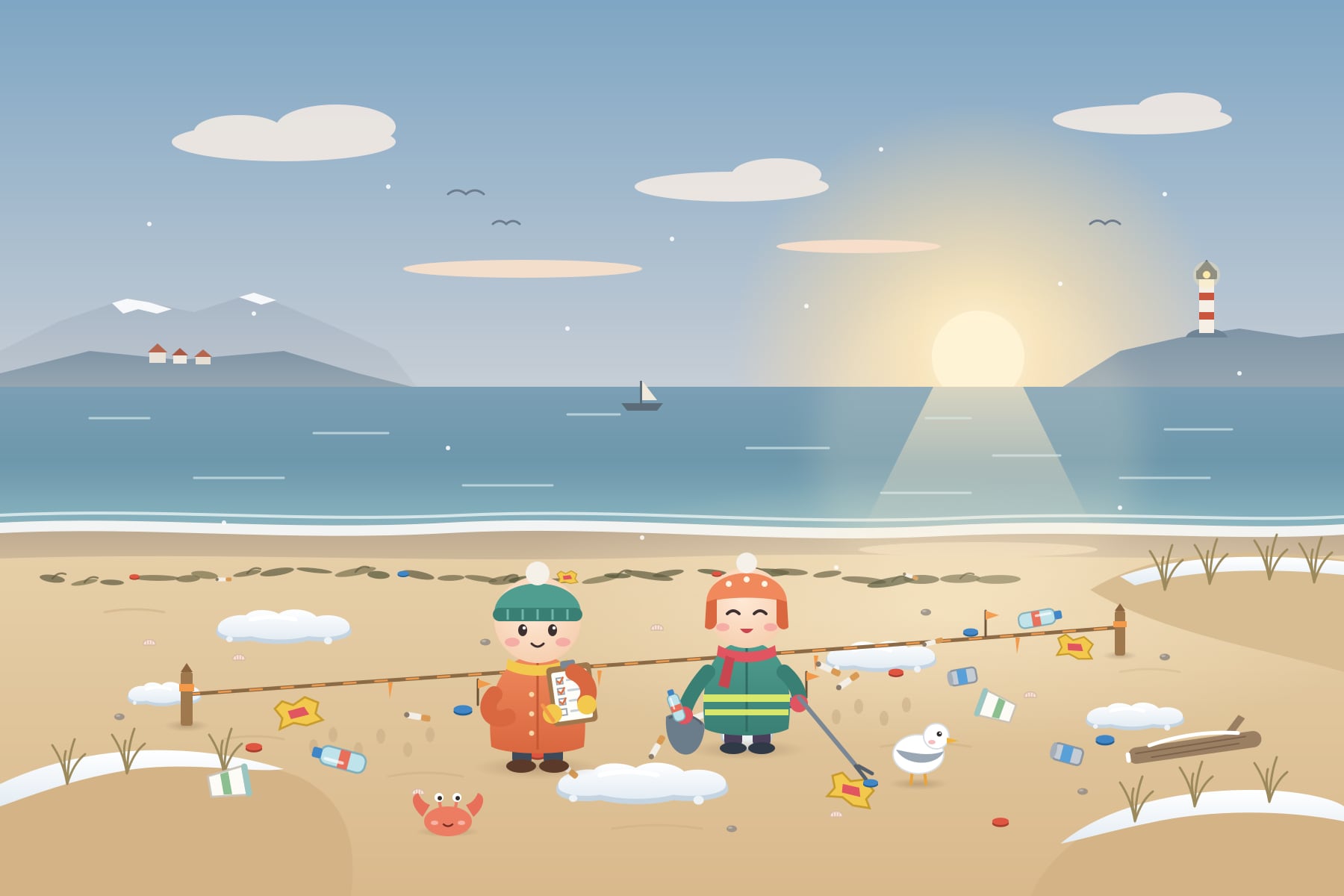
Counting litter changes laws: how beach counts shaped EU rules, and how to run a winter survey
Volunteer litter counts on fixed 100 m stretches gave the EU its Single-Use Plastics Directive and still measure whether it works. Here is the evidence chain, and a step-by-step protocol for a winter survey on a beach, riverbank, park edge or trail.
Since July 2024, every plastic drinks bottle sold in the European Union has had its cap attached. It is a small, slightly annoying piece of design, and it exists because people walked along beaches with clipboards and counted. Their tallies showed that plastic caps and lids turn up in nature 2 to 3 times more often than the bottles they came from.
A bag of rubbish shows that a place is dirty. A count, done the same way in the same place again and again, shows what the rubbish is, where it comes from and whether things are improving. Here is how that evidence led to EU law, and how you can run a winter litter survey worth sharing.
The short version
- Counts became law: standard 100 m beach surveys produced a ranking of the most common items, and the EU's Single-Use Plastics Directive targets the top 10 plus fishing gear.
- It is working, slowly: litter on EU beaches fell by 29% between 2015 to 2016 and 2020 to 2021, but most seas are still far above the EU threshold of 20 items per 100 m.
- The Black Sea is worst: a median of 684 items per 100 m in 2020 to 2021, the highest of Europe's four seas.
- Brands are data too: volunteer brand audits link more than half of branded plastic litter to 56 companies.
- Anyone can contribute: a fixed 100 m stretch, a standard tally list and a record of effort turn a winter walk into useful data.
From a clipboard to a directive
The 100 m method
Under the OSPAR guidelines for the North-East Atlantic, surveyors visit a fixed 100 m section of beach four times a year, in winter, spring, summer and autumn, and record every litter item against an agreed list. Fragments are counted one by one. Because the stretch, the list and the timing stay the same, a Dutch beach can be compared with an Irish one, and this year with five years ago. The EU's Marine Strategy Framework Directive uses the same logic, with an item list built on the older UNEP and OSPAR lists.
The top items list
In 2016 the European Commission's Joint Research Centre ranked the most frequent beach litter items. It combined OSPAR surveys, an earlier consultancy review and data from Marine LitterWatch, a European Environment Agency citizen science programme launched in 2013 that let community groups upload their own counts. The report admitted this was not an exact measurement, but the spread of top items across Europe was "not very big". The same bottles, caps, wrappers, cotton bud sticks and cigarette butts appeared from the Baltic to the Black Sea.
The Single-Use Plastics Directive
That ranking became the backbone of Directive (EU) 2019/904. According to the European Environment Agency, it targets the 10 single-use plastic items most often found on EU beaches, which make up 43% of marine litter, plus fishing gear, another 27%. The ten are cotton bud sticks; cutlery, plates, straws and stirrers; balloons and their sticks; food containers; cups; drinks containers; cigarette butts; bags; crisp packets and sweet wrappers; and wet wipes and sanitary items.
Each got a measure that fitted the problem. Some, such as plastic straws and cotton bud sticks, were banned. Others got labels, producer responsibility schemes or design rules. The attached cap is a design rule, and it came straight from the counts.
Plastic caps and lids are found 2 to 3 times more often than bottles in nature, so the EU required them to stay attached. A design rule written from a tally sheet.
Is it working?
The surveys that built the law now measure it. The European Environment Agency reports that coastline litter larger than 2.5 cm fell from 287 to 203 items per 100 m between 2015 to 2016 and 2020 to 2021, a 29% drop. The Commission says single-use plastic litter fell by 40% over the same period. The EEA calls the numbers indicative, because the data is uncertain.
The picture is uneven. Median counts per 100 m in 2020 to 2021 were 684 on the Black Sea, 233 on the Mediterranean, 173 on the North-East Atlantic and North Sea, and 16 on the Baltic. The EU threshold for good environmental status is 20. Only the Baltic is below it. The Black Sea median is about 34 times the threshold, which matters for everyone on the Bulgarian coast.
OSPAR's assessment for 2018 to 2023 found plastic made up 93% of beach litter on the Atlantic side, and the most common item was unidentifiable plastic fragments between 2.5 and 50 cm. Its goal is a 70% cut by 2030 against 2015 to 2016. By the end of 2023 the reduction was 18.2%. Progress is real, but well short of the plan.
Global counts and brand audits
The International Coastal Cleanup
Ocean Conservancy's International Coastal Cleanup, held each September, is the longest-running volunteer litter dataset. For 2025 it reported more than 630,000 volunteers and 7.92 million pounds of material removed, according to Resource Recycling, and Science Times reported nearly 13.9 million items. Plastic bottles led at about 1.34 million, followed by about 1.2 million cigarette butts and 885,854 bottle caps. The WHO tobacco convention secretariat estimates that 4.5 trillion butts are littered worldwide every year, and their filters are a plastic.
Brand audits
Counting tells you what. Brand audits tell you who. Break Free From Plastic's latest global audit, in 2023, had 8,804 volunteers log 537,719 pieces of plastic in 41 countries. The top parent companies were Coca-Cola, Nestlé, Unilever, PepsiCo, Mondelēz International, Mars, Procter & Gamble, Danone, Altria and British American Tobacco.
The data has been through peer review too. A 2024 study in Science Advances, summarised by Australia's science agency CSIRO, analysed 1,576 audit events in 84 countries. Half the items had no visible brand. Of the branded ones, more than half were linked to 56 companies, and Coca-Cola alone to 11%. A 1% increase in a company's plastic production was associated with a 1% increase in its plastic pollution. That is evidence for producer responsibility rules, where companies pay for the waste their packaging creates.
Why weight is not enough
The Ocean Cleanup says it passed 50 million kg removed from rivers and the ocean in March 2026. In Bulgaria, the 2026 Let's Clean Up Bulgaria Together campaign collected over 1,400 tonnes with nearly 18,000 volunteers, according to the environment ministry. These self-reported totals show scale. But a tyre outweighs a thousand cigarette butts, and a kilogram cannot tell a council whether to add butt bins or talk to a takeaway shop. Item counts can.
What 2026 microplastics science adds
Every large item you count is a future source of fragments. A Nature study in November 2026 found microplastics in the blood of 43 of 47 tapirs and giant anteaters in Brazil, some living more than 65 km from roads and towns. A European Heart Journal study of 61 patients found particles more often in people who had had heart attacks, though its authors stressed this does not prove cause. Methods are still maturing: University of Michigan chemists showed that particles from lab gloves can be mistaken for polyethylene. The safe reading is that microplastics are widespread, health effects are uncertain, and stopping big items before they break apart is the part anyone can do.
How to run a winter litter survey
Winter is a good time to start. Vegetation dies back on riverbanks and park edges, exposing hidden litter, and snowmelt reveals what was dropped in autumn. OSPAR's method includes a winter survey as one of its four a year, and a winter baseline makes later counts easier to read.
What to bring
- thick puncture-resistant gloves, a litter picker and two strong bags;
- a printed tally sheet, a clipboard and a pencil (ink freezes);
- a charged phone with GPS and a power bank, since cold drains batteries;
- two markers, such as tent pegs, for the ends of your stretch;
- warm layers, a hi-vis vest and a small first aid kit.
The protocol, step by step
- Choose a site you can return to: a beach, riverbank, park edge or trail. Find out if and when the municipality cleans it.
- Fix a transect: mark 100 m. On a beach, survey from the water line to the back of the beach. On a riverbank or trail, keep a fixed width, such as 2 m either side of the path. Record GPS points and a photo of each end.
- Set a schedule: monthly for a local study, or four times a year to match OSPAR.
- Record effort: date, start and end time, number of people, transect length and width.
- Record conditions: weather, recent storms or floods, and the share of the transect under snow, ice or water.
- Count everything over 2.5 cm: walk slowly, in a line if you are a group, and tick each item on the tally list.
- Record brands: photograph the brand side of bottles, cans, wrappers and cigarette packets and transcribe them later.
- Take photos: an overview before and after, plus close-ups of anything notable, such as dumped building waste.
- Weigh if you can: weigh the full bags at the end. It is an extra, not a replacement for counts.
- Dispose properly and enter the data the same day, before memory fades and paper gets wet.
A simple tally list
This follows the OSPAR and EU monitoring categories, with a few winter additions. Keep it the same every visit.
- plastic fragments 2.5 to 50 cm;
- plastic drinks bottles;
- caps and lids;
- food containers and takeaway boxes;
- polystyrene pieces;
- cups and cup lids;
- cutlery, plates, straws and stirrers;
- crisp packets, sweet wrappers and lolly sticks;
- plastic bags, including dog waste bags;
- cigarette butts;
- cigarette packets and lighters;
- wet wipes, cotton bud sticks and sanitary items;
- balloons and balloon sticks;
- rope, string, nets and fishing line;
- glass bottles and pieces;
- drinks cans and other metal;
- paper and cardboard;
- textiles and shoes;
- rubber, including tyre pieces;
- face masks and disposable gloves;
- fireworks debris (count these after New Year);
- sharps seen (note the place, never touch);
- other (describe).
Counting or weighing?
Counting reveals sources, compares with European data and captures light items like butts that barely register on a scale. Weighing is easier for big groups and suits councils that think in tonnes. If you can only do one, count.
Data hygiene
- No double counting: remove items as you count them.
- Record zeros: a survey that finds nothing is a result.
- Not surveyed is not zero: if snow covers half the transect, record that.
- Keep the method fixed: same stretch, width and list. Note any change.
- Note cleanings: your count then measures what built up since.
Staying safe in winter
- Wear heavy gloves throughout and wash your hands afterwards.
- Never pick up needles or hazardous waste. Note the location and report it to the municipality.
- Keep away from icy, steep or flooded water edges, and never enter the water.
- Avoid fast roads and verges without a pavement.
- Postpone in storms or ice, finish well before dark, and never go alone.
Where to send your data
- Marine Debris Tracker: a free open data app started in 2010 by the US NOAA Marine Debris Program and the University of Georgia, for beaches and inland sites.
- Clean Swell: Ocean Conservancy's free app, usable worldwide and offline, feeding the International Coastal Cleanup database.
- Marine LitterWatch: the EEA's web app is being phased out without technical support. The EEA now points individuals to the MARNOBA app and groups to its Reportnet 3 platform.
- Garbamons: pin a litter spot at the start of your transect, with photos and your counts, so others can see it and plan a cleanup.
Turning numbers into action
- Summarise simply: items per 100 m, the top five items and the change since your first visit, on one page with two photos.
- Add a benchmark: the EU threshold of 20 items per 100 m puts your number in context.
- Ask for something specific: write to your municipality's environment department about more bins, more frequent emptying or a butt bin at a bus stop.
- Talk to businesses: if one kiosk's cups or one brand's bottles dominate, show the owner or write to the company.
- Measure the result: keep surveying after a change. A before and after comparison on the same transect is the strongest evidence a volunteer can produce.
What you can do this winter
- Pick one 100 m stretch near home and survey it before the end of December.
- Repeat it in January to catch fireworks and holiday packaging, and again in February.
- Pin a litter spot for your transect so others can follow.
- Find or start an event and turn a group cleanup into a counted survey, with one person on the tally sheet.
- Read more articles on cleanups and citizen science.
Small counts, big rules
The attached cap on your bottle shows that tally sheets can reach Brussels. Europe's beach litter law was built from thousands of 100 m walks, many by volunteers, and it is judged by the same walks. The Black Sea is still far from the EU threshold. Closing that gap needs cleanups, and it needs steady, honest, repeated counts. A cold morning, a clipboard and 100 m of shore is a good place to start.
Facts and figures were checked against the sources below on 14 November 2026. Volunteer cleanup totals are reported by the organisers, and the EEA describes EU beach litter figures as indicative.
Sources and further reading
- European Commission: 5 things you should know about single-use plastics
- EUR-Lex: Directive (EU) 2019/904 on the reduction of the impact of certain plastic products on the environment
- European Environment Agency: Litter found on European beaches
- European Environment Agency: EU coastline macro litter trends
- OSPAR Commission: Beach litter abundance, composition and trends 2018 to 2023
- JRC: Marine Beach Litter in Europe, Top Items (Hanke, 2016)
- EU Water Observatory: How to contribute to Marine LitterWatch
- Resource Recycling: Bottles most recovered waste in coastal cleanup
- Science Times: Global coastal cleanup removes 13.9 million pieces of plastic
- Ocean Conservancy: Clean Swell app
- Marine Debris Tracker
- Break Free From Plastic: Brand Audit 2023
- CSIRO: Global study finds more than half of branded plastic pollution linked to 56 companies
- The Ocean Cleanup: Milestones
- The Ocean Cleanup: 2025 in review
- Ministry of Environment and Water of Bulgaria: Let's Clean Up Bulgaria Together 2026
- WHO FCTC: 4.5 trillion cigarette butts end up littered every year
- Phys.org: Microplastics found in the blood of wild mammals far from cities
- News-Medical: Micro and nanoplastics in the blood linked to heart attack risk factors
- The Conversation: Scientists may be overestimating microplastics, and the culprit is lab gloves
- Reigate and Banstead Borough Council: Litter picking, safe systems of work