 Garbamons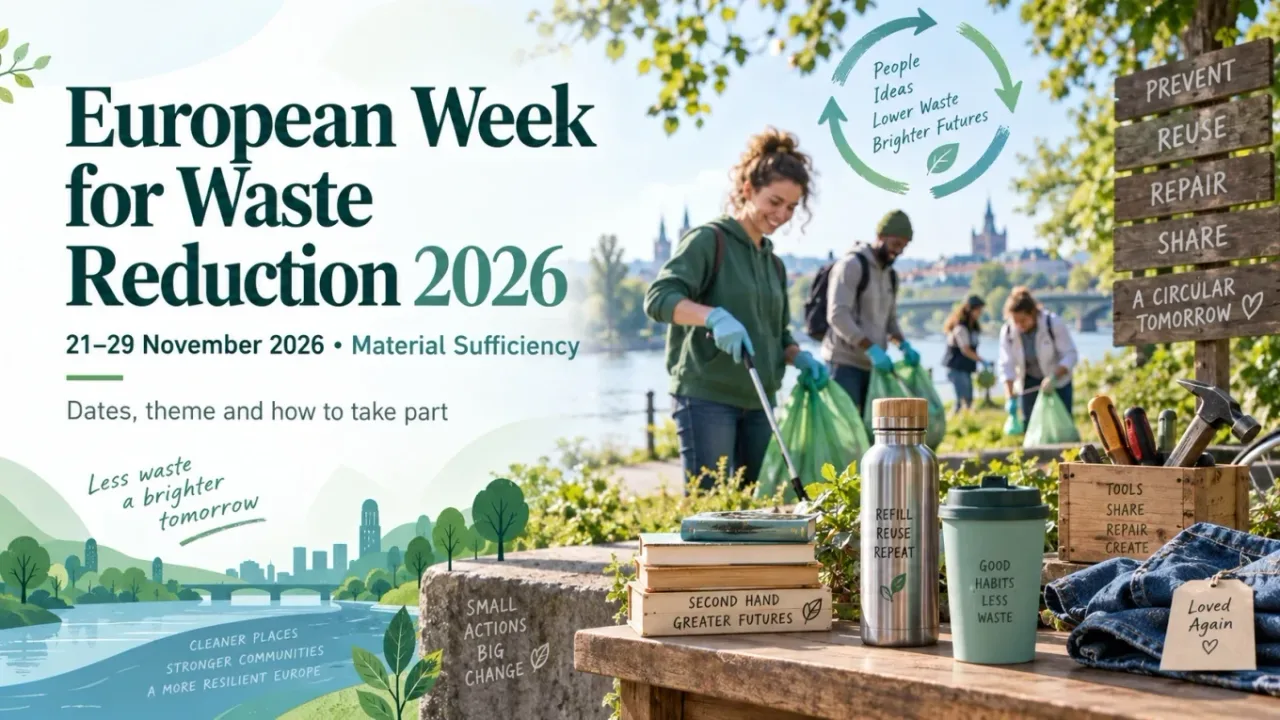
European Week for Waste Reduction 2026: Dates, Theme and How to Take Part
The European Week for Waste Reduction (EWWR) takes place from 21 to 29 November 2026, with the theme “Material Sufficiency.” Registration for actions runs from 1 September to 15 November. The campaign brings together people and organisations to explore how to use fewer resources and prevent waste before it is created.[1]
The European Week for Waste Reduction (EWWR) takes place from 21 to 29 November 2026, with the theme “Material Sufficiency.” Registration for actions runs from 1 September to 15 November. The campaign brings together people and organisations to explore how to use fewer resources and prevent waste before it is created.[1]
For anyone who has picked up litter from a beach, park or riverbank, the event raises a practical question: what would stop some of those same items appearing again?
A cleanup addresses waste that is already there. A waste-prevention action looks further back: at the disposable item handed out unnecessarily, the equipment bought for a single afternoon, or the repairable object replaced too soon. This year's theme is an opportunity to connect the two—to clean a place, understand a recurring problem and test a change that could reduce it.
This guide explains the event, the 2026 participation routes and several activities you can adapt for a community group, school, workplace or household. It also shows how to report results without confusing waste collected with waste prevented.
Event information checked on 17 September 2026. Reconfirm local schedules, availability and booking arrangements with the relevant host.
European Week for Waste Reduction 2026 at a glance
Detail Confirmed information Event dates 21–29 November 2026 Annual theme Material Sufficiency Action registration 1 September–15 November 2026 Who can get involved Citizens, schools, businesses, associations and public authorities Where it happens A network of locally organised actions, rather than one central venueDates, theme and participant groups are confirmed in the official 2026 announcement. The campaign's participation guide explains how to organise an action or join someone else's.[2][3]
The 15 November deadline is for registering an action with the campaign. Booking a place at a particular workshop or cleanup is a separate process: follow that host's instructions.
What is the European Week for Waste Reduction?
EWWR is an annual awareness-raising campaign centred on waste prevention and more sustainable resource use. It began in 2009 as a project supported by the EU's LIFE+ programme. Its European coordinator is ACR+, the Association of Cities and Regions for sustainable Resource management, working with national, regional and local coordinators.[4]
The organisers report 13,107 actions in the 2025 edition. That is a count of activities—not a measurement of tonnes prevented or individual participants—but it illustrates the campaign's distributed format. A classroom investigation and a city-wide programme can both sit within the same event.[4]
For a first-time organiser, the useful starting point is not “How do we run an enormous environmental event?” It is “Which avoidable source of waste can our group realistically change?”
Keep that question narrow. A school might investigate unfinished lunches. A residents' group might establish a shared equipment cupboard. A cleanup team might work with a venue to reduce one recurring category of disposable packaging. Define one problem clearly before adding more activities.
What does “Material Sufficiency” mean?
ACR+ describes material sufficiency as rethinking how much we consume, what we actually need and how production and consumption are organised. Repair, shared use, second-hand goods and longer-lasting products are among the approaches it highlights. Its supporting material frames sufficiency around maintaining wellbeing while reducing material demand—not simply lowering quality of life.[5][6]
A useful way to understand the idea is to distinguish making a product with fewer materials from meeting a need without acquiring another product.
Imagine a neighbourhood organising occasional cleanups. Buying a lighter litter picker changes the product. Borrowing suitable equipment from an existing shared store changes how the group meets its need. Both are worth examining, but the second asks the question at the heart of sufficiency: does everyone need to own another item?
The same question can guide a workplace meeting. Before searching for a different kind of disposable cup, check whether the venue already has suitable washable cups and the capacity to use them. Before ordering branded giveaways for a waste-reduction event, ask what purpose they serve.
This is not a rule that every reusable item automatically has a lower environmental footprint. For your action, examine the actual arrangement: what is already available, what needs purchasing, who will maintain it, how often it will be used and what happens when it fails. Avoid claiming a lifecycle benefit you have not assessed.
Why prevention is different from recycling
The EU waste hierarchy puts prevention ahead of preparing for reuse, recycling, other recovery and disposal. The distinction is important: recycling concerns materials that have entered the waste system; prevention seeks to avoid generating waste in the first place.[7]
Eurostat reports that the EU generated 517 kilograms of municipal waste per person in 2024. Municipal waste includes household waste and similar waste from sources such as commerce and public institutions. It is not a figure for litter alone, nor a measure of everything an individual personally throws away.[8]
For an EWWR activity, separate three questions:
- Prevention: What can we stop becoming waste?
- Reuse and repair: What can remain useful for longer?
- Collection and treatment: How will we responsibly handle what is already waste?
A cleanup can address the third question while providing clues for the first. Keep the results separate rather than labelling every bag collected “waste prevented.”
How to take part in EWWR 2026
Join an existing activity
Start with the official EWWR action finder. Search for a city or organiser and use the available location, date and theme filters to find relevant 2026 listings.[9]
Contact the host before travelling. Confirm the meeting point, start and finish times, whether booking is required, any participation costs, age restrictions and accessibility arrangements. For an outdoor activity, also ask about equipment, weather-related cancellation and the level of physical effort involved.
A listing is not necessarily a public drop-in invitation: it may describe a classroom project or an internal workplace activity. EWWR advises prospective participants to ask organisers whether they can join. It also notes that many actions are registered in November, so an empty early search is a reason to check again, not proof that nothing will happen nearby.[3]
Organise and register your own action
Before opening a form, write a one-sentence aim. For example:
“During our community club's November meetings, we will trial the venue's existing washable cups and record how many disposable cups are issued per 100 drinks.”
That gives you a defined setting, a practical change and something observable. “Raise awareness about waste” can be part of the purpose, but it is not yet an operating plan.
Next, find the correct registration route. Germany, France, Hungary, Catalonia and Asturias use separate coordinator platforms. Follow the official external-registration instructions rather than assuming every action belongs in the general form.[10]
For the central route, the action registration page requires an account login. Read the Action Developers' Participation Charter linked from the participation page. Your coordinator can clarify suitability; ACR+ covers territories without a national, regional or local coordinator.[11][3]
As preparation—not as a substitute for the form—have your title, location, date, audience, contact details, activity plan and intended measure of success ready. Confirm venue access, partner responsibilities and any collection arrangements before promoting places to participants.
Use the campaign's published 15 November 2026 registration deadline as the latest planning boundary, not the date to begin organising. Allow time to resolve questions with your coordinator.[2]
What do real 2026 activities look like?
The official action directory already contains plans that show how different formats can work. These are announced activities, not completed projects or verified impact results.
A classroom waste investigation in Malta
“Think Before You Bin! – A Year 3 Waste Detective Experiment”, listed for 23–27 November at Birkirkara Primary School, plans to combine classroom waste observations with counting, comparison and writing. Pupils will record a baseline, consider alternatives before discarding items and repeat the investigation. The listing describes a school project, not an open public workshop.[12]
The adaptable idea is the sequence: observe, change something specific, then observe again. A display made from litter is not the only educational format available.
An escape-room activity near Madrid
“Scape Room: Operación R” is listed for 28 November at Centro de Educación Ambiental El Águila in Chapinería, in Spain's Madrid region. Its planned team challenges focus on refusing, reducing, reusing and repairing. The host says participant booking opens on 13 November; consult its listing for contact details and availability.[13]
That booking date is a useful reminder to distinguish joining an event from registering an event. Check the relevant host's process even when you already know the overall campaign dates.
Four practical EWWR activities to adapt
The formats below are planning suggestions, not claims about activities already delivered by Garbamons. Choose one that fits the people, equipment and time you actually have.
1. Turn a cleanup into a waste-prevention experiment
For a cleanup group, make the question more specific than “How much rubbish can we collect?” Try: “Which recurring item could we reduce at this place, and who could help change the situation?”
Choose a manageable, clearly defined site. During the cleanup, record common item categories as well as collection totals. Note the area covered, duration, number of volunteers and conditions. NOAA's Marine Debris Program encourages recording debris during cleanups; for formal shoreline monitoring, it provides a separate standardised survey programme.[14][15]
Afterwards, select one pattern to investigate. Suppose you repeatedly record takeaway cups near a community venue. That is an observation, not proof that the venue caused the litter. Ask about how drinks are served, where people gather and what existing reuse arrangements could be tested. Garbamons' guide, “A beach item is a clue, not a verdict”, explains why finding an item does not establish its source.[16]
Separate a prevention change, such as avoiding unnecessary disposable cups, from a containment change, such as improving a bin's location or servicing. Both may be relevant to the site, but they address different parts of the problem.
Agree on a follow-up visit before the group disperses. Record what changed and what did not. A lower litter count on one later visit is not, by itself, proof that your intervention caused the reduction; weather, use of the site and other cleanups may differ.
Resolve the waste handoff first. Get confirmation of what the land manager or collection partner will accept, how it must be separated, where it will be left and who will remove it. Do not assume a recycling symbol means your locally collected material will be accepted.
For outdoor work, follow the host's site-specific safety arrangements. The Marine Conservation Society's 2026 organiser guide calls for landowner permission and a risk assessment, and warns volunteers not to touch needles, suspicious containers or potentially dangerous objects. Keep clear and alert the organiser or responsible authority; do not attempt uncertain heavy or partly buried lifts.[17]
The result to aim for is a documented cleanup and a specific prevention trial—not a larger pile of bags for the photograph.
2. Run a repair-and-reuse session with a clear destination for every item
Start with a narrow, achievable offer: clothing repairs, book exchanges or a session supported by an experienced local repair group. The Repair Café model centres on learning and repairing together with volunteers, rather than simply dropping off an object and expecting it back fixed.[18]
Ask repairers what they can safely handle before inviting the public. Do not advertise electrical, battery or other specialist repairs without suitable expertise and arrangements. Where that support is unavailable, a textile-mending session is a more manageable proposal than an unrestricted “bring anything” event.
For an exchange table, publish acceptance conditions in advance. State the item categories, condition requirements and what happens to leftovers. Ask any receiving charity or reuse organisation to confirm what it can take; do not name it as a destination without agreement.
Keep repair and swap records distinct. An object inspected is not necessarily repaired. A donated item is not necessarily reused. Record items repaired, awaiting parts, taken by a new user and returned to their owner separately. A short follow-up can ask whether successfully repaired items are still in use.
Set expectations about costs too. Repair Café's published house rules say volunteer labour is free, but replacement materials or parts can cost extra; repair is not guaranteed. An independently organised EWWR workshop may have different arrangements, so explain your own clearly.[19]
Before finishing, identify who will maintain the contact list, host another session or keep the exchange operating. Avoid collecting more objects than your team has a realistic route to reuse.
3. Test a lower-waste routine at a school, workplace or club
Choose one repeated activity: serving drinks, distributing meeting materials or lending equipment. Repetition gives you something concrete to compare before and during the trial.
For a drinks service, first count disposable cups issued and drinks served during a normal, defined period. Then test a workable alternative using suitable equipment already available where possible. Confirm washing capacity, storage, collection points and who does the additional work. Follow the venue's hygiene and accessibility requirements rather than imposing a single arrangement on everyone.
A useful trial might be “washable cups available at every club meeting during the campaign,” with an agreed exception where someone needs a different option. Record those exceptions instead of treating them as failures or hiding them.
The same structure works for a shared cleanup kit. Inventory existing usable equipment, record loans and returns, name a storage contact and agree responsibility for cleaning, repairs and replacement. A cupboard full of donated tools is not yet a functioning lending system.
Budget for the work, not only the objects. Storage, transport, washing, supervision and administration all need an owner. Confirm any partner contribution before including it in the plan.
At the end, decide whether the arrangement is practical enough to continue. A measured reduction in disposable items is useful; a system nobody can maintain needs revision.
4. Investigate one source of avoidable food waste
For a household, start with a brief food-waste diary. Record what was discarded and why: too much prepared, forgotten ingredients, an unsuitable portion or a purchase that was never used. For a school or workplace, involve the catering team rather than adding a waste audit without their agreement.
Keep the scope consistent. Separately record avoidable edible food and inedible parts where your method allows. Count meals served as well as waste: a quieter day is not automatically a better-performing day.
Choose one change suggested by the observations. That might be revising a shopping quantity, making an already-owned ingredient easier to notice or testing a smaller initial portion with the option of more. Do not turn the exercise into pressure to eat unwanted food.
Food safety remains the boundary. For example, official UK guidance distinguishes a use-by date, which concerns safety, from a best-before date, which concerns quality, and stresses following storage instructions. Use the relevant official guidance for your location; do not treat a waste-reduction challenge as permission to ignore safety dates or handling requirements.[20]
The useful outcome is not simply “we composted more.” Report whether less avoidable food was discarded under comparable conditions, and explain the limits of the comparison.
A realistic preparation timeline
The following is a suggested working schedule. Only the campaign dates and registration deadline are official; adapt the preparation stages to your action.[2]
When What to have in place September–October One defined problem, an organiser, a suitable partner or venue, and a feasible activity. Early November Responsibilities, access, resources, booking information and any waste handoff confirmed. Before registration closes on 15 November Action submitted through the correct campaign or coordinator route; outstanding questions addressed. Before your trial begins A baseline recorded using the same method you intend to repeat. 21–29 November The activity delivered, observations recorded and follow-up responsibilities agreed. December Results reviewed, unresolved items followed up and a decision made about continuing the change.Keep a cancellation or alternative-format plan where outdoor access depends on conditions. For public activities, publish practical access information: surfaces or steps, toilets, seating, language, supervision requirements and a contact for questions. Offer non-physical roles such as recording or welcoming participants where the activity allows.
How to measure results without overstating them
A useful report tells the reader what happened, how it was measured and what remains uncertain. Do not merge awareness, collection, reuse and prevention into one impressive-looking total.
Match the measure to the activity
Activity Record directly Do not assume Cleanup Items or measured weight collected, area covered, effort and collection destination. Collected waste equals waste prevented. Repair session Items assessed, repaired, awaiting parts and still in use at follow-up. Every item brought in was saved from disposal. Swap or reuse event Items accepted, taken for use, left over and returned or transferred elsewhere. Every donated item found a useful new home. Disposable-item trial Items issued relative to services delivered, such as cups per 100 drinks. Lower totals prove improvement when attendance also fell. Food-waste trial Clearly defined waste categories and meals served in comparable periods. More composting proves less food was wasted.This is a proposed reporting framework, not an official EWWR scoring system.
A worked example: disposable cups
The following numbers are hypothetical. They illustrate a calculation, not results from an actual Garbamons or EWWR event.
Measure Baseline period Trial period Drinks served 400 500 Disposable cups issued 320 150 Disposable cups per 100 drinks 80 30The calculation is:
Disposable cups per 100 drinks = cups issued ÷ drinks served × 100.
At the baseline rate of 80 disposable cups per 100 drinks, serving 500 drinks would imply 400 cups. The trial issued 150: 250 fewer than that baseline-rate comparison.
A defensible report would say:
“Disposable-cup use fell from 80 to 30 cups per 100 drinks during our trial. For the 500 drinks served, this was 250 fewer disposable cups than would have been issued at the baseline rate. We have not measured lifecycle emissions or established whether the change will persist.”
That is more informative than “We saved 250 cups” without an explanation of the comparison. It also does not claim that every issued cup was discarded immediately, or that the trial's whole environmental footprint has been calculated.
Keep a short evidence record
Use this reusable structure:
Action and location: What took place, and where?
Dates and scope: Which period, area or service was measured?
Starting point: What was recorded before the change?
Change tested: What did the group actually do differently?
Method and result: What was counted or weighed, and how?
Destination: Where did collected waste or remaining items go?
Limitations: What could affect the comparison?
Follow-up: Who will check again, and when?
For litter records, note weather, recent cleaning, the area surveyed and volunteer effort. Use consistent categories and disclose missing information. Where a project claims formal shoreline monitoring, follow a published protocol rather than presenting an improvised count as a standardised survey.[15]
Garbamons' guide to turning litter into actionable data develops this approach for cleanup reports and repeat visits.[21]
Avoid converting bags into kilograms without weighing them, counting the same repaired-and-swapped item twice in a combined total, or publishing carbon savings without a suitable method and stated assumptions. “We do not know yet” belongs in an honest report when the outcome has not been checked.
Frequently asked questions
Does every action have to follow the Material Sufficiency theme?
No. EWWR says its annual theme is encouraged but not mandatory. Other waste-related activities can be proposed; consult the participation charter and your coordinator about your specific plan.[22]
Can individuals and small informal groups participate?
Yes. EWWR's citizen category includes individuals, families, groups of friends and neighbourhood groups. You do not need to establish an organisation simply to propose an action.[3]
Can people outside the European Union get involved?
The campaign's invitation is not limited to EU residents: its official site welcomes participation beyond Europe too. Check the coordinator directory and ask ACR+ about the appropriate route where your territory is not represented.[1][3]
Does an activity have to run for all nine days?
The published 2026 directory includes single-day activities as well as multi-day projects. Plan a duration that fits your action within the campaign period, and confirm any relevant requirements with your coordinator.[12][13]
Make the next step more specific than “waste less”
For this European Week for Waste Reduction, choose one place, one avoidable source of waste and one change your group can realistically test. Register through the official route, record the starting point and agree on a follow-up before the activity ends.
For cleanup volunteers, the lasting question is not only how much litter left the site. It is whether anything changed that could prevent more from arriving. For a school or workplace, it is whether the routine still works when the campaign posters come down.
Garbamons can provide a place to map litter, document a cleanup and share a follow-up report.[23] Keep that community record distinct from official participation: registering an EWWR action happens through the campaign or its designated coordinator, not through a Garbamons report.
Start with the official EWWR participation guide or browse the 2026 action directory. Then give your plan a practical endpoint: a documented result, a named person responsible for the next step and a date to check what changed.
Sources and further reading
Event dates and participation information were checked on 17 September 2026. Activity suggestions, the planning timeline and the worked calculation are editorial tools developed for this article; they are not official EWWR requirements. The two named 2026 examples are organiser-published plans, not independently verified outcomes.
European Week for Waste Reduction, official 2026 homepage. Dates, annual theme, registration window and geographical invitation. ↩1 ↩2
ACR+, “Registration for EWWR 2026 opens on 1 September”, 31 August 2026. ↩1 ↩2 ↩3
EWWR, “Take part”. Participation routes, citizen category, charter, coordinator fallback and guidance on joining activities. ↩1 ↩2 ↩3 ↩4 ↩5
EWWR, “Discover”. Campaign history, coordination and reported action counts. ↩1 ↩2
ACR+, “Material sufficiency at the heart of EWWR 2026”, 23 February 2026. ↩
ACR+, “New EWWR factsheet – Why is sufficiency the way forward to tackle the waste crisis?”, 20 July 2026. Summary of material developed with Zero Waste Europe. ↩
European Commission, “Waste Framework Directive”. Overview of the waste hierarchy. ↩
Eurostat, “Municipal waste statistics”. 2024 data; page data extracted in January 2026. ↩
EWWR, official action finder. Searchable action listings and map. ↩
EWWR, “External registration required”. Separate routes for Asturias, Catalonia, Germany, France and Hungary. ↩
EWWR, action registration page. Account login requirement for the central registration route. ↩
EWWR action listing, “Think Before You Bin! – A Year 3 Waste Detective Experiment”. Planned for 23–27 November 2026 in Birkirkara, Malta. ↩1 ↩2
EWWR action listing, “Scape Room: Operación R”. Planned for 28 November 2026 in Chapinería, Spain; participant booking information supplied by the organiser. ↩1 ↩2
NOAA Marine Debris Program, “How to Help”. Community prevention, reuse and cleanup guidance. ↩
NOAA Marine Debris Program, “Marine Debris Monitoring and Assessment Project”. Standardised shoreline-monitoring resources. ↩1 ↩2
Garbamons, “A beach item is a clue, not a verdict”. Interpreting litter observations without overclaiming their source. ↩
Marine Conservation Society, Beachwatch organiser guide, updated 2026, especially PDF pages 4 and 6. Safety and permission guidance is specific to that programme; follow the requirements of your own host and location. ↩
Repair Café International, “About”. Repair Café's collaborative repair model. ↩
Repair Café International, “House rules”. Repair limitations, parts and materials, and volunteer labour. ↩
GOV.UK, “Best before and use-by dates”. UK food-labelling guidance; consult the appropriate authority for your location. ↩
Garbamons, “Turn litter into actionable data, not just a before-and-after photo”. Practical recording and follow-up principles. ↩
EWWR, “Get Inspired”. Annual themes are encouraged, not mandatory. ↩
Garbamons, About. Community mapping, cleanup records and events. ↩