 Garbamons
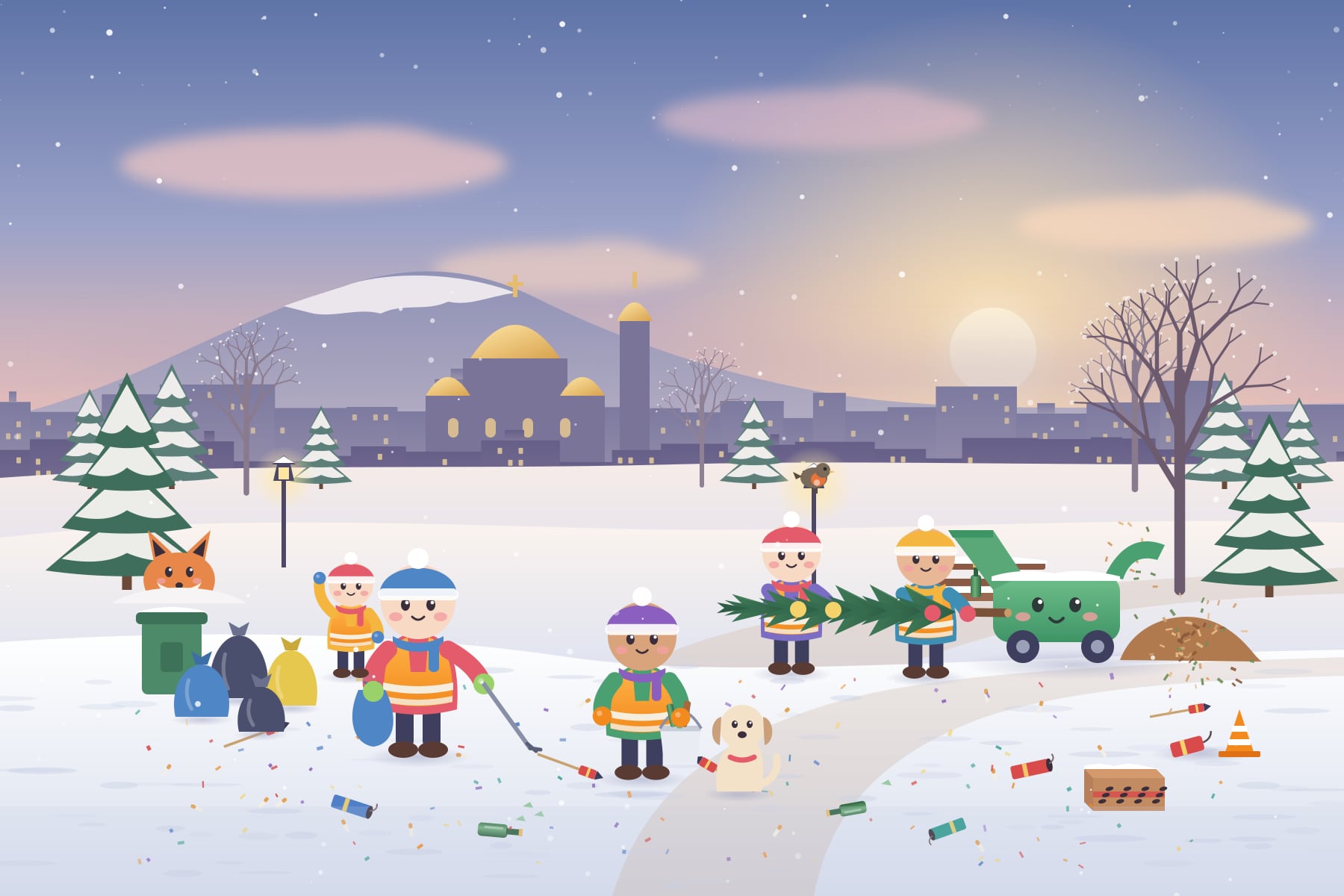
Christmas trees, fireworks and the morning after: a guide to a cleaner New Year
Real or artificial tree, what to do with it in January, what fireworks do to air, animals and streets, and how to organise a safe New Year's Day cleanup, with Sofia's rules and a short checklist.
In Germany, fireworks release about 2,050 tonnes of fine particulate matter every year, and most of it goes up in a few hours around midnight on New Year's Eve. In Bulgaria, the environment ministry measured particle levels over large cities that were 2 to 3 times higher on that night than on the evening before or the morning after.
The air clears within a day or two. What stays behind is visible on 1 January: rocket sticks in the parks, broken bottles on the squares, butts in the gutters, and soon dried-out Christmas trees by the bins. This guide follows the season from choosing a tree to a safe cleanup the morning after.
The short version
- Trees: There is no single break-even number for real versus artificial trees. An artificial tree only wins if you keep it for many years, and a real tree is best when it is grown locally, cut legally and chipped or composted afterwards.
- In Bulgaria: A legally cut tree carries a numbered plastic control plate under the second branch from the top. Trees in containers do not need one.
- January: Never burn the tree in a stove or fireplace and never dump it in a forest. Ask your municipality about collection or green waste points.
- Fireworks: In Sofia, F2 and F3 fireworks are allowed outdoors only from 18:00 on 31 December to 02:00 on 1 January. They harm air, wildlife and pets, and leave plastic and cardboard behind.
- The morning after: Never touch an unexploded firework you find. Keep people away and call 112.
- Cleanup: A New Year's Day or first-weekend cleanup works best when it is short, well briefed, in daylight and agreed with the municipality in advance.
Real or artificial: what the life-cycle studies say
The honest answer is that it depends. Life-cycle studies compare the emissions from making, transporting and disposing of each type of tree, and they do not agree on the details.
Figures from the Carbon Trust, quoted widely by the media, give a two-metre artificial tree a footprint of about 40 kg of CO2 equivalent, mostly from manufacturing. A real tree that is burnt or chipped comes to about 3.5 kg. If the same real tree goes to landfill, where it rots without oxygen and releases methane, its footprint rises to about 16 kg.
How many years does an artificial tree need to be used to break even? A 2009 study by the Montreal consultancy Ellipsos found about 20 years. A 2018 study commissioned by the American Christmas Tree Association, which represents artificial tree makers, found about five years across the impacts it measured. Other estimates sit in between, often around 7 to 10 years. The gap comes from assumptions about transport, growing methods, materials and, above all, what happens to the real tree at the end.
The greenest tree is the one you already have. If you own an artificial tree, keep using it for as long as possible. If you buy a real one, buy local and make sure it is chipped or composted.
Carbon is not the whole picture. Artificial trees are usually made of PVC and metal and are hard to recycle. Real trees are often grown as monocultures with pesticides, but legally sold ones come from farms and nurseries rather than wild forest.
Potted trees: what helps them survive
A tree in a pot sounds ideal, but many do not survive replanting. Extension advice from the University of Florida (UF/IFAS) gives clear rules:
- Keep the indoor stay short: about 7 to 10 days. Longer weakens the tree before it goes back outside.
- Acclimatise both ways: a few days in a cool, sheltered place such as a balcony before bringing it in and before planting it out. Bulgaria's forestry agency gives the same advice.
- Water carefully and keep it cool: roots moist but never standing in water, and well away from radiators and stoves.
- Plan the planting site: a fir or spruce grows large. Choose a place with space and keep watering after planting until it is established.
Ask whether the tree was grown in its container: one that always lived in its pot keeps its whole root system.
Buying legally in Bulgaria
Because young conifers are sometimes cut illegally, the Executive Forest Agency (IAG) checks markets and transport in December. According to the agency, a legally cut Christmas tree must carry a plastic control plate with a series and a six-digit number, fixed under the second branch from the top. The plates are white and rectangular, or yellow with an oval shape on one side. The number is recorded on the transport ticket that follows the trees from the place where they were cut to the market.
Trees with a closed root system, sold in containers, do not need a plate. If a cut tree has no plate, do not buy it. The agency asks people to report suspected illegal trade by calling 112. Buying directly from a state forestry enterprise's plantation or nursery is a simple way to be sure of the origin.
What to do with the tree in January
A real tree only keeps its low footprint if it ends up as mulch or compost. Many cities run January collections. In San Francisco, for example, Recology collected bare trees from the kerb between 2 and 16 January 2026 and composted close to 590 tons of them. Other cities run drop-off points and give the chips back as garden mulch.
We could not find a confirmed Christmas tree collection scheme for Sofia for this winter. If you live in Bulgaria:
- Ask your district administration or municipality whether they collect trees separately or accept them as green waste, and where.
- Take the tree to a green waste or garden waste point if your town has one.
- If you have a garden, cut the branches and add them to a compost heap, or use them to cover sensitive plants over winter.
Whatever the route, remove all tinsel, wire, hooks, lights and the plastic net first. Collection schemes only accept bare trees.
Two things never to do
Do not burn it indoors. Iowa State University Extension warns that dry evergreen branches can flare up suddenly when burned and may cause a house fire, and that burning a tree adds to creosote build-up and the risk of a chimney fire. It also adds smoke to winter air that is often already poor.
Do not dump it in the forest or a park. A tree with a net and leftover tinsel is waste, and dumped trees attract other rubbish. If you see a dumping spot, pin it on Garbamons so it can be cleared.
Fireworks: air, animals and litter
The air
Germany's Federal Environment Agency (UBA) has the most detailed figures. Fireworks there produce about 2,050 tonnes of PM10 a year, around 1,700 tonnes of which is the even finer PM2.5. That is about 1% of Germany's annual PM10, released almost entirely in one night. In the hours after midnight, hourly PM10 levels can reach several thousand micrograms per cubic metre, and many stations break the EU daily limit of 50 µg/m³ on 1 January. During the pandemic restrictions of 2021 and 2022, these peaks were missing.
In Bulgaria, the Ministry of Environment and Water analysed monitoring data for New Year's Eve 2021 to 2022 and found PM10 levels over large cities 2 to 3 times higher than the evening before and the morning after. People with asthma or heart disease, and small children, are better off indoors with the windows closed.
Wildlife and pets
A 2023 review in Pacific Conservation Biology by Bateman, Gilson and Bradshaw describes overwhelming evidence that fireworks harm wildlife, domestic animals and the environment. Among the studies it cites:
- In a New Zealand survey, owners reported fear responses in 74.4% of companion animals.
- In Beebe, Arkansas, displays in 2011 and 2012 caused thousands of red-winged blackbirds to die in collisions during panicked night flights.
- In Valencia, house sparrows bred less successfully in towns with firework festivals, and the difference disappeared when festivals were cancelled in 2020.
Fireworks also release metals and perchlorates that can build up in food chains. The authors recommend local bans near sensitive sites and a switch to drone or laser shows, which are quieter and smoke-free, although drones can still disturb wildlife.
The rules in Sofia
Sofia bans the outdoor use of category F2 and F3 fireworks, such as firecrackers, rockets, Roman candles and batteries, except from 18:00 on 31 December to 02:00 on 1 January. F1 items such as sparklers are treated separately, and police patrols enforce the ban. The rule was reported in this form in December 2024, so check this year's municipal announcements.
The city itself has moved away from fireworks. At its New Year's Eve concerts of 2024 and 2025 on Knyaz Alexander I Square, the municipality used a light show instead, citing children, pets and people who suffer from loud bangs. For midnight on 1 January 2026, the Finance Ministry also planned a drone show to mark Bulgaria joining the euro. Plans for this New Year's Eve had not been announced when this guide was written.
What fireworks leave behind
The UBA also lists large amounts of waste and plastic among the effects of fireworks. Rockets leave sticks and plastic caps, batteries leave cardboard blocks with plastic parts, and firecrackers leave paper scraps. Much of it lands in hedges, rivers and snow. Some of it has not exploded at all, which is why the morning after needs care.
The other New Year litter
- Bottles and glass: Bottles left on benches and in snow get broken. Glass injures people, pets and wildlife, and is the main risk on a cleanup.
- Cigarette butts: The WHO Framework Convention on Tobacco Control estimates that 4.5 trillion cigarette butts are littered every year. Filters are made of cellulose acetate, a plastic, and do not biodegrade on streets or beaches.
- Confetti and glitter: Plastic and metallic confetti spreads into drains and is almost impossible to collect. Since 17 October 2023, EU microplastics rules restrict loose plastic glitter. Paper confetti is still litter, so use it only indoors, if at all.
How to organise a safe New Year cleanup
A cleanup on 1 January or the first weekend of the year needs more planning than a summer one: broken glass, possibly live fireworks, cold and only about nine hours of daylight. In Sofia, the sun rises at about 07:57 and sets at about 17:03 on 1 January 2027.
- Pick a place and survey it. Choose a park, square or riverside you know was busy on New Year's Eve. Walk it beforehand and pin the worst litter spots with a photo.
- Ask permission and arrange collection. Contact your district administration or municipality, or the park operator, in December. Ask whether permission is needed and agree where full bags go and when they are collected. In protected areas, ask the park directorate. Uncollected bags become new litter.
- Choose the time. Late morning on 1 January or the first weekend works well. Start in full daylight and finish well before dark. Two hours is plenty in the cold.
- Create the event. Start an event on Garbamons with the meeting point, start time, area, requirements and what people should bring. Link your pins and share the invitation link.
- Prepare equipment. Heavy-duty gloves for everyone, litter grabbers, strong bags in several colours for sorting, a rigid bucket or box for glass, a first aid kit, hand sanitiser and water. Hi-vis vests are useful near paths and roads.
- Give a safety briefing. Explain the area's boundaries, the rules below and how to report an injury. Reigate and Banstead council's volunteer guide is a good model.
- Sort as you go. Keep glass in a bucket or double-bagged, take intact bottles to glass containers, and bag cans and plastic bottles separately. Firework tubes and blocks that have clearly burnt out go with general waste.
- Finish and record. Count the bags, photograph the cleaned place and the bag pile, and wash hands before eating or drinking.
Safety rules for the briefing
- Gloves on at all times, and use grabbers. Never pick anything up with bare hands. Cover cuts with a waterproof plaster and keep hands away from your mouth and eyes.
- Needles and sharps: do not touch them. Mark the place, keep people away and report it to the municipality.
- Glass: pick it up with a grabber, never by hand, and never press glass down into a bag.
- Unexploded fireworks: never touch, kick, relight or bin them, because a dud can still go off. Keep everyone and dogs away and call 112 with the exact location.
- Roads and water: stay off roads and away from riverbanks, lakes and ice. Supervise children at all times.
- Cold: layers, waterproof shoes, a warm drink and short breaks. Postpone in ice, storms or extreme cold.
A note on duds at home
If one of your own fireworks fails, never relight it. Safety guidance such as Wisconsin's health department's says to wait 15 to 20 minutes, then soak it in a bucket of water. Anything you find in a public place is for the police or fire service.
What you can do
- Plan the tree's end now: ask your municipality in December where trees will be collected in January.
- Celebrate without fireworks: go to a light or drone show. If you do use fireworks, keep to the legal hours and pick up every stick and tube next morning.
- Protect pets: keep them indoors with curtains closed, and walk dogs early in the evening.
- Take it home: bottles and butts go home with you. Smokers can carry a pocket ashtray.
- Clean up on 1 January: find or start an event near you, and when the job is done, open the pin and use "This place is cleaned now" with a photo. You can credit everyone who helped, even without an account.
- Keep reading: find more practical guides in our articles.
A cleaner start to the year
None of this means giving up the tree or the midnight toast. A tree that is chipped instead of dumped, a party without plastic confetti and a dozen neighbours with gloves on the first weekend of January make a visible difference to a park, and make it more likely to stay clean next year.
Checklist
- Tree: reuse the artificial one, or buy local with a control plate. Potted: 7 to 10 days indoors at most.
- January: bare tree to collection or a green waste point. Never burn indoors, never dump.
- Fireworks: legal hours only, or choose a light show. Pets indoors.
- Found fireworks: do not touch, keep people away, call 112.
- Cleanup: permission and collection agreed, daylight, briefing, gloves, glass separate, photos and a Garbamons report.
Facts and figures were checked against the sources below on 14 November 2026. Local rules and New Year's Eve plans change each year, so check your municipality's announcements in December. This guide does not replace instructions from the police, fire service or municipality.
Sources and further reading
- Umweltbundesamt (German Federal Environment Agency): Fine particulate matter from New Year's Eve fireworks
- Novinite: On New Year's Eve the air in Bulgaria was 2 to 3 times more polluted than normal (January 2022)
- BNT: Sofia welcomes the New Year with a light show, no fireworks (December 2024)
- BTA: Sofia welcomes New Year with open-air concert and light show (December 2025)
- Sofia Globe: Special drone show to be held over Sofia as Bulgaria joins the euro
- Bateman, Gilson and Bradshaw (2023): Not just a flash in the pan, short and long term impacts of fireworks on the environment. Pacific Conservation Biology
- WHO FCTC: 4.5 trillion cigarette butts end up littered in our lakes, oceans and soil every year
- Truth Initiative: Why are cigarette butts the most littered item on Earth?
- Executive Forest Agency (IAG): Buyers of Christmas trees should check for a control plate (in Bulgarian)
- Agrozona: Executive Forest Agency fines for illegally cut Christmas trees (in Bulgarian)
- Asparagus Magazine: Are artificial or real Christmas trees better for the environment?
- Euronews: Fact check, is a real or artificial Christmas tree better for the environment?
- Carbon Trust: Tips for a more sustainable Christmas
- UF/IFAS Gardening Solutions: Living Christmas trees
- Iowa State University Extension: After the holidays, can I burn my Christmas tree in the fireplace?
- SF Environment: Recycle the right way this holiday season
- Reigate and Banstead Borough Council: Health and safety guide for volunteer and community litter picking
- Wisconsin Department of Health Services: Fireworks safety
- WorkSafe Western Australia: Finding explosives or fireworks
- European Commission: Restriction of microplastics intentionally added to products