 Garbamons
PureFlow: High-School Students in Türkiye Turn Mussel-Shell Waste into Water-Treatment Media
A team from Diyarbakır turns discarded mussel shells into a treatment medium for industrial wastewater. The reported capacity still needs independent testing.
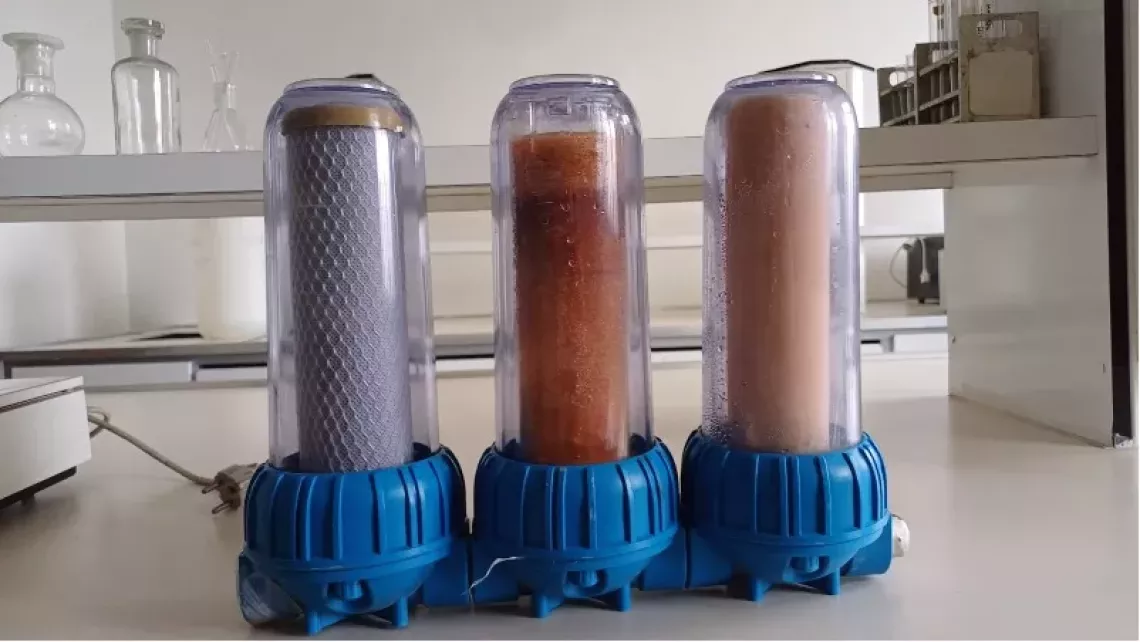
A water filter built around a waste material
PureFlow is a youth-developed filtration project that uses discarded mussel shells as the basis of a reusable treatment medium. The project was created by three high-school students from Diyarbakır, identified in UNICEF's public materials as Yusuf, Cemre and Öykü, working as Team Inspire. UNICEF Türkiye published the project in April 2025 after the team won the international Generation Unlimited imaGen Ventures Global Youth Challenge.
The core environmental idea is circular: mussel shells that would otherwise enter the waste stream are processed into material capable of interacting with contaminants in wastewater. UNICEF describes the system as removing harmful pollutants including heavy metals and toxic dyes. Generation Unlimited describes it as a filtration material for industrial wastewater, including applications relevant to textile and chemical manufacturing.
Why mussel shells can be useful in water treatment
Mollusc shells are composed primarily of calcium carbonate, usually in crystalline forms such as calcite or aragonite, along with a smaller organic fraction. Calcium-rich mineral surfaces can interact with dissolved metals through adsorption, ion exchange, surface complexation and precipitation mechanisms. When shell material is crushed, heat-treated or chemically modified, its surface area and reactivity can be changed substantially.
Public UNICEF materials do not provide the full PureFlow manufacturing protocol. However, a later Accenture case study describing UNICEF/Generation Unlimited work characterizes PureFlow as using nanoporous mussel shells enhanced with magnesium oxide . That description is useful because magnesium oxide is itself a reactive alkaline material with a strong history in adsorption and water-treatment research. The exact shell treatment, MgO loading, pore structure and regeneration procedure would still need to be published before the process can be independently reproduced.
What contaminants does it target?
Those categories are broad. A mature technical specification would identify exact contaminants, such as lead, cadmium, chromium or named dyes, along with starting concentrations, final concentrations, contact time and treatment standards.
- Heavy metals: UNICEF explicitly identifies heavy metals as a target class.
- Toxic dyes: particularly relevant to textile wastewater, where strongly coloured organic molecules can be difficult to remove.
- Organic/industrial pollutants: Generation Unlimited describes the material more broadly as improving industrial water reusability.
How a PureFlow-type filter likely functions
The publicly shown prototype consists of cartridge-like filtration units. Water would pass through or contact the shell-derived media, allowing contaminants to bind to the reactive surfaces. Depending on the precise treatment of the shells, several mechanisms may occur simultaneously:
These mechanisms are standard scientific possibilities for calcium- and magnesium-rich sorbents; they should not be confused with a fully disclosed PureFlow recipe. The team has not publicly released a detailed process flow sheet or peer-reviewed sorption-isotherm study in the sources reviewed here.
- Physical filtration through packed porous material;
- Adsorption of dissolved pollutants onto shell or MgO surfaces;
- Surface precipitation of metal ions as less-soluble mineral phases under alkaline conditions;
- Electrostatic and chemical interactions between dye molecules and modified mineral surfaces.
Reported performance and cost
UNICEF makes a striking capacity and cost claim: each filter can purify up to one million litres of water at a cost of US$50,000 and is described as 54% more cost-effective than other systems. Because this figure appears in a programme profile rather than a peer-reviewed engineering study, it should be read as a reported project estimate. The public page does not show the baseline technology used for the 54% comparison, contaminant loading, replacement frequency, labour costs or how the one-million-litre capacity was calculated.
UNICEF also states that Team Inspire worked with university experts and conducted laboratory testing, and that the experiments demonstrated effective contaminant removal and produced clean water. No public analytical table was found in the reviewed sources listing initial/final contaminant concentrations, detection limits, replicate counts or certification against drinking-water standards. This is therefore a promising lab-validated prototype, not yet a fully characterized commercial filter.
Why the project emerged in Diyarbakır
UNICEF links the team's motivation to growing water stress in Türkiye and to local concern in Diyarbakır. The students saw water scarcity not only as a question of obtaining more water, but also as a reason to make contaminated water more reusable. This is especially relevant for industrial users: if wastewater can be treated and reused internally, freshwater demand and pollutant discharge can both be reduced.
PureFlow therefore addresses two environmental pressures simultaneously: water pollution and resource scarcity . It also creates a potential use for shell waste, which strengthens its circular-economy rationale.
Awards and programme support
- Competition: Generation Unlimited imaGen Ventures Global Youth Challenge
- Result: Global winning project from Türkiye, according to UNICEF / Generation Unlimited
- Support ecosystem: UNICEF Türkiye and Habitat Association; university experts were involved in laboratory validation
- Development plan: Turn the filter into a fully operational purification machine, field-test it, run pilot programmes and train local youth/entrepreneurs
What still needs to be published
- Exact surnames/ages are not given on the main UNICEF profile; this article therefore does not guess them.
- Full media composition and manufacturing process.
- Specific heavy metals/dyes tested and their initial concentrations.
- Removal percentage, adsorption capacity (for example mg contaminant per g media), breakthrough curves and flow rate.
- Regeneration method and number of reuse cycles.
- Disposal or recycling method for contaminant-loaded shell media.
- Performance in real industrial wastewater rather than simplified laboratory solutions.
- Independent cost comparison supporting the reported 54% advantage.
- Any drinking-water certification if the project is intended for potable use; industrial reuse and drinking-water treatment require different evidence.
What PureFlow shows
PureFlow is technically interesting because it sits in an established area of environmental engineering, adsorption and reactive filtration, but starts from an unusually accessible waste feedstock. Its value proposition is easy to understand: take shell waste, increase its treatment value, pack it into reusable cartridges, and target pollutants that prevent wastewater reuse. The scientific questions are also clear and testable, which makes the project well suited to progression from a youth prototype into university-supported validation.
The project will become much more compelling if Team Inspire publishes a detailed materials characterization and controlled performance dataset. Until then, the one-million-litre capacity and cost claims should be considered promising programme-reported estimates rather than independently established commercial specifications.
Evidence note
Evidence note: UNICEF describes successful laboratory testing, but the detailed analytical methods and raw results are not publicly presented on the programme page. The reported one-million-litre capacity and 54% cost advantage should therefore be treated as project/programme claims pending independent technical documentation.
Sources
- UNICEF Türkiye , official PureFlow profile (29 April 2025)
Official UNICEF project profile and reported programme claims. (LINK_ONLY)
- Generation Unlimited , 2024/5 imaGen Ventures Global Winners, PureFlow entry
Programme profile and challenge context. (LINK_ONLY)
- Generation Unlimited , Stories of Impact
Programme profile and challenge context. (LINK_ONLY)
- Accenture / UNICEF GenU case study , describes nanoporous mussel shells enhanced with magnesium oxide
Programme case study with additional material and development details. (LINK_ONLY)
- UNICEF Türkiye , Turkish-language version
Official UNICEF project profile and reported programme claims. (LINK_ONLY)