 Garbamons
Eco Purge: Arya Satheesh's Enzyme-Carrying Bioplastic Designed to Degrade Existing Microplastics
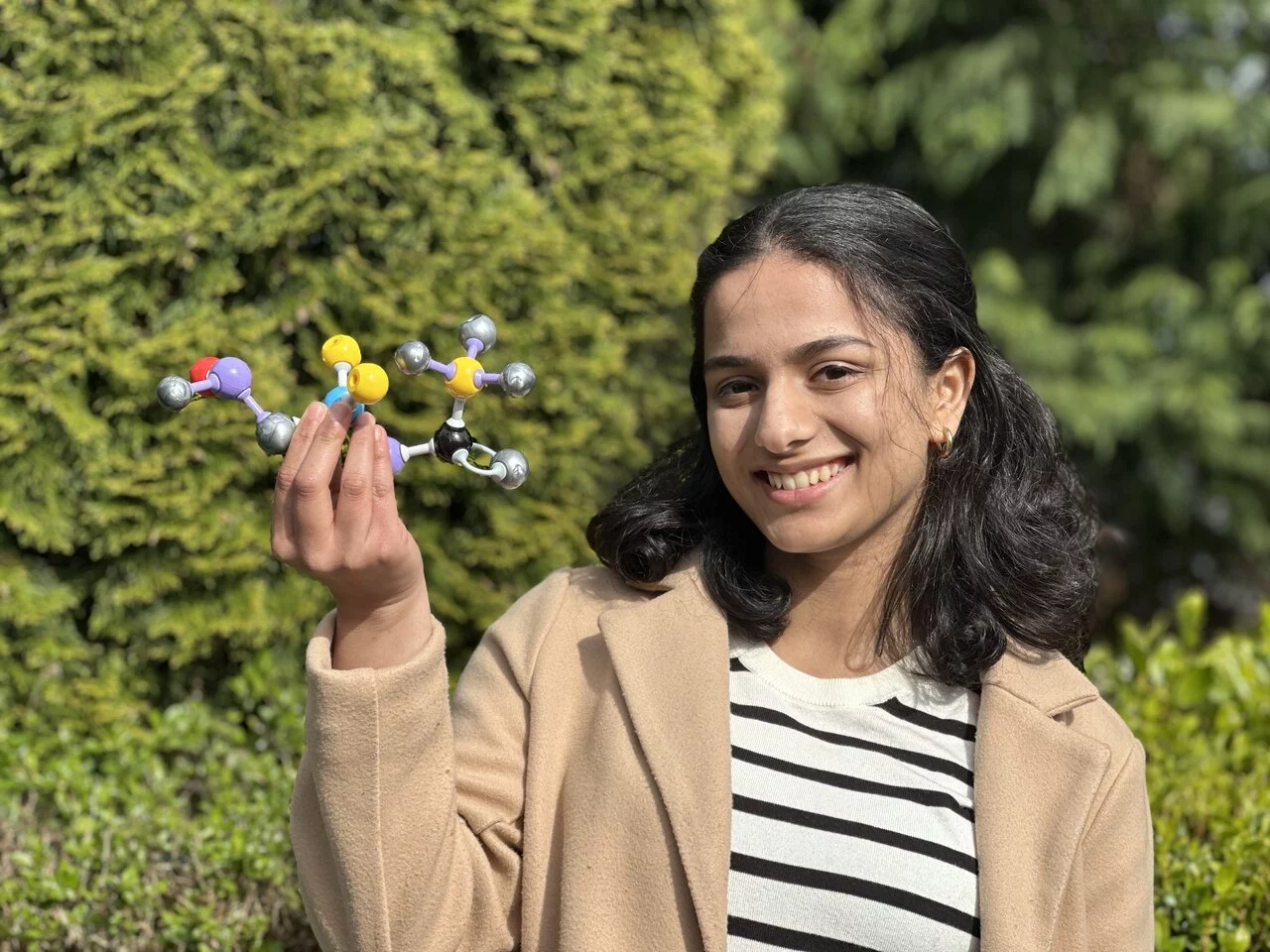
Arya Satheesh designed a biodegradable carrier that releases enzymes intended to break down nearby microplastics. The early result needs fuller analytical evidence.
The unusual idea: make a replacement plastic that also cleans up older plastic
Most biodegradable-plastic projects aim to reduce future pollution: replace a conventional material with one that breaks down more readily after use. Arya Satheesh's Eco Purge adds a second function. The material is designed to carry plastic-degrading enzymes so that, as the biodegradable carrier itself breaks down, it gradually releases active catalysts into the surrounding environment. Those catalysts are intended to attack microplastics already present in soil, freshwater or saltwater.
That makes Eco Purge an active-remediation material rather than only a lower-persistence replacement. Satheesh, an 18-year-old student from Letterkenny, won the European category of The Earth Prize 2026 and received US$12,500 to continue development.
Where the idea came from
Satheesh had previously worked on a water-quality monitoring project. The monitoring work exposed an important limitation: detecting microplastic contamination does not remove it. She then began investigating how plastics can be degraded biologically and how enzymes might be incorporated into another material without losing their activity.
The Irish Times reports that her project was entered under the title Eco Purge: Biodegradable Plastic with Enzyme-Driven Microplastic Degradation . Earth Prize materials describe the carrier as plant-based and biodegradable.
How Eco Purge is intended to work
- Manufacture a plant-based biodegradable carrier plastic.
- Embed selected plastic-degrading enzymes/catalysts in the material. The challenge is keeping them stable during manufacturing and storage.
- Use the material as a product. Proposed future forms include packaging and compost bags.
- Allow the carrier to biodegrade after disposal. Public project descriptions say the Eco Purge material itself can break down over a short period, with Smithsonian reporting up to roughly two weeks for the carrier under the described concept.
- Release active enzymes gradually. As the carrier degrades, enzymes enter the surrounding soil or water.
- Enzymes attack susceptible microplastics. The intention is that the released catalyst continues degrading plastic fragments already present nearby.
What Satheesh tested
Smithsonian's 2026 profile reports that Satheesh placed a measured amount of microplastic together with Eco Purge in different environments, including soil, salt water and fresh water, and observed the systems for six weeks. By the end of that period, the article reports that both the Eco Purge material and the microplastic contaminants had degraded.
This is an important proof-of-concept result, but the public article does not provide the complete underlying dataset: exact polymer type and molecular weight, enzyme name/concentration, microplastic particle size, mass-loss percentage, degradation products, controls, temperature, pH, microbial conditions or analytical methods. Those details would be necessary to determine whether the microplastic was fully mineralized, depolymerized into smaller molecules, physically fragmented, or otherwise transformed.
The science behind enzyme-driven plastic degradation
Enzymes are biological catalysts that can accelerate specific chemical reactions. Some plastics contain chemical bonds that certain enzymes can hydrolyse, breaking long polymer chains into smaller molecules. PET is a well-known example: enzymes in the broader PETase/cutinase family can attack ester bonds in polyethylene terephthalate under suitable conditions.
The challenge is selectivity. "Microplastics" are not one material; they include polyethylene, polypropylene, polystyrene, PET, nylon and many other polymers. An enzyme highly effective on one polymer may do little to another. A commercial Eco Purge product would therefore need a clearly defined target-plastic spectrum or a mixture of enzymes with complementary activity.
Why embedding the enzyme is hard
The carrier must protect the enzyme long enough for the product to be manufactured, stored and used, then release it after disposal. Enzymes can lose activity when exposed to high heat, solvents, extreme pH or unfavorable interfaces. That means manufacturing temperature and polymer chemistry are critical. A successful formulation must balance:
- mechanical strength during use;
- sufficient shelf life;
- controlled biodegradation after disposal;
- enzyme stability before release;
- enzyme activity after release;
- safe degradation products.
University collaboration and prize funding
The Earth Prize says Eco Purge had developed into a working prototype and had involved collaboration with researchers at University College Dublin, Atlantic Technological University (ATU) Letterkenny and the BiOrbic Bioeconomy Research Centre. The 2026 European Winner award brought US$12,500 in prize funding for further development.
Satheesh has discussed scaling the idea into everyday products such as packaging and compost bags. That route could make the remediation function widespread, but it would also require rigorous environmental-risk testing because deliberately releasing active enzymes into open environments has to be evaluated for ecological persistence, allergenicity, non-target effects and breakdown products.
What makes Eco Purge different from ordinary biodegradable plastic
- Main goal is for the product itself to break down after disposal.: Carrier breaks down and releases catalysts intended to degrade nearby microplastic.
- Environmental benefit is largely preventive.: Environmental benefit is both preventive and potentially remedial.
- No active catalyst necessarily leaves the material.: Controlled enzyme release is central to the design.
Critical questions before real-world use
- Which polymers? The target plastic range must be explicitly defined.
- How complete is degradation? Breaking a polymer into smaller fragments is not enough; ideally it should be converted into benign monomers or ultimately mineralized.
- What products are formed? Chemical analysis is required to ensure no harmful intermediates are created.
- How long do enzymes remain active? Activity in soil, freshwater and seawater can differ sharply.
- What is the dose? The amount of enzyme released per gram of material determines cost and environmental loading.
- Can manufacturing be scaled? Enzyme-compatible processing may be more expensive or temperature-sensitive than conventional plastics processing.
- What happens to ecosystems? Long-term ecotoxicology and non-target organism testing will be necessary.
Why Eco Purge matters
Eco Purge is one of the more unusual youth environmental inventions of 2026 because it treats a material as a delivery vehicle for cleanup chemistry. The idea is to make the bag's end-of-life process perform an environmental function. If the enzymes remain active, work across relevant plastics and produce safe end products, the concept could become a platform for materials that carry their own remediation chemistry.
The caveat is equally important: enzyme-driven plastic degradation is chemically specific and difficult to validate. The six-week proof-of-concept is encouraging, but peer-reviewed analytical evidence will be needed before the technology can be assessed as a broad microplastic-removal solution.
Evidence note
Evidence note: Public reporting describes successful six-week degradation observations, but a peer-reviewed paper with full analytical data was not identified in the sources used here. "Degraded" should not automatically be interpreted as complete mineralization until chemical end-products are measured.
Sources
- The Earth Prize , official 2026 European Winner announcement and media
Official competition announcement, project description, or media resource. (LINK_ONLY)
- Smithsonian Magazine , detailed August 2026 profile and six-week test description
Reported technical profile with prototype testing details. (LINK_ONLY)
- The Irish Times , project title, background and university-collaboration details
Reported profile or project reference supplied with the research draft. (LINK_ONLY)
- The European , 2026 profile of Satheesh and Eco Purge
Reported profile or project reference supplied with the research draft. (LINK_ONLY)