 Garbamons
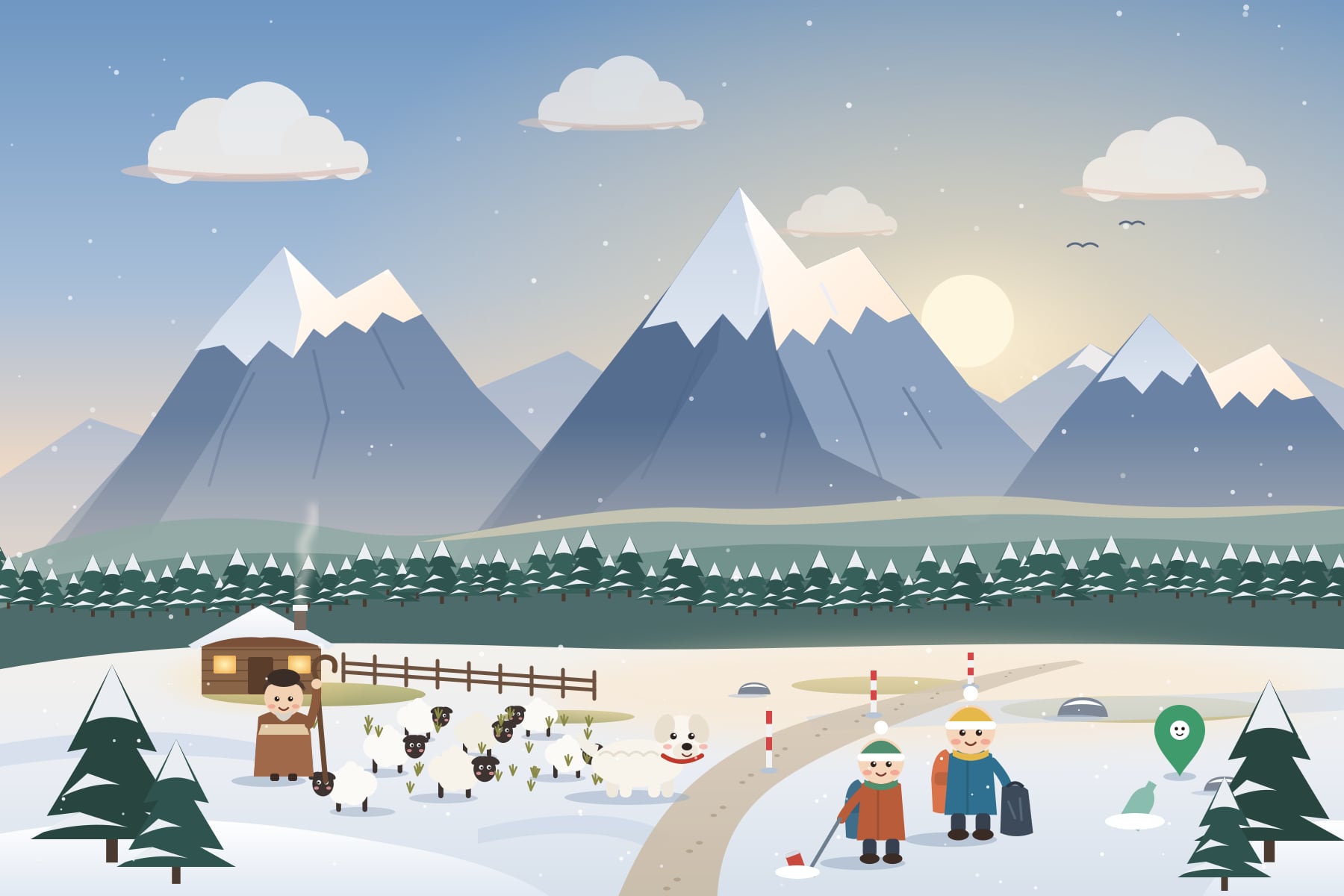
International Mountain Day 2026: herders, pastures and how to keep winter mountains clean
On 11 December the world marks International Mountain Day with a focus on pastoralists and rangelands. Why mountains matter, how litter harms grazing animals, and a practical field guide to leaving no trace on winter trails, slopes and pastures.
Over a third of Switzerland's farmland is alpine pasture. In Kyrgyzstan, 85% of all agricultural land is pasture. And about 70% of Colombia's freshwater starts in its mountain rangelands. These numbers, from the Food and Agriculture Organization of the United Nations (FAO), explain why this year's International Mountain Day is about the people who graze animals on high ground and the land they keep alive.
International Mountain Day falls on Friday 11 December 2026. Its theme is "Mountain pastoralists: Sustaining rangelands, knowledge and livelihoods", and it comes at the end of the International Year of Rangelands and Pastoralists. For anyone who walks, skis or cleans up in the mountains, it is also a good moment to ask a simple question: what happens to the things we leave behind on a pasture?
The short version
- The day: International Mountain Day is on Friday 11 December 2026, with the theme of mountain pastoralists and rangelands. FAO coordinates it and invites anyone to register an event.
- Why mountains matter: They cover about 27% of the Earth's land, hold about a quarter of its land biodiversity and supply 60 to 80% of the world's freshwater, according to FAO.
- Litter hurts herds: Grazing animals swallow plastic, twine, wire and can fragments. Surveys of slaughtered animals and veterinary records show the damage is real and sometimes fatal.
- Winter hides waste: Snow covers litter and cold slows its breakdown, so what is dropped in December often reappears on pastures in spring.
- What to do: Pack everything out, including peels and cigarette butts, stay on marked trails, give herds and guardian dogs space, and record litter safely instead of chasing it into risky terrain.
Why mountains matter
FAO estimates that mountains cover around 27% of the Earth's land surface and are home to almost 15% of the world's population. Their reach goes far beyond the people who live on them. Mountains store water as snow and ice and release it slowly through springs and rivers, which is why they are often called the world's water towers. FAO puts their share of the world's freshwater at between 60 and 80%.
They are also crowded with life. Steep slopes pack many climates into a short distance, so mountains hold about a quarter of the world's terrestrial biodiversity. FAO notes that sheep, goats, yaks, alpacas and llamas all originated or diversified in mountains, and that six of the 20 plant species that supply 80% of the world's food did too.
Life up there is not easy. In 2020 FAO reported that the number of mountain people in developing countries vulnerable to food insecurity had risen from 243 million in 2000 to almost 350 million in 2017.
Rangelands and the people who keep them
What rangelands are
Rangelands are lands grazed by animals rather than ploughed: grasslands, savannas, shrublands, deserts, wetlands and high mountain meadows. FAO says they cover about half of the Earth's land surface and hold about 30% of the world's soil organic carbon. About half of them are degraded.
What pastoralists do
Pastoralists are people who live from herding. FAO estimates they herd about 1 billion animals, from sheep and goats to cattle, yaks, camels and reindeer, and are present in more than 75% of countries. They manage at least a quarter of the world's land. In mountains, moving herds up to summer pastures and back down in autumn keeps meadows open and flower-rich, and FAO says about 1.2 billion people live in mountain areas that benefit from healthy mountain rangelands.
The UN General Assembly declared 2026 the International Year of Rangelands and Pastoralists in resolution A/RES/76/253, adopted on 15 March 2022 at the initiative of Mongolia and other countries. FAO's Mountain Day page also warns that climate change, land degradation and competing land uses are cutting grazing corridors and access to water and markets.
How litter harms grazing animals and pastures
Cattle, sheep and goats graze by wrapping their tongues around mouthfuls of vegetation. They do not pick out every wrapper or shard. Once something indigestible reaches the rumen, the first and largest stomach, it can stay there.
Plastic in the rumen
A postmortem study in eastern Ethiopia, published in 2015, checked the rumen and reticulum of 810 slaughtered animals. Foreign bodies turned up in 144 of 332 cattle, 109 of 193 sheep and 169 of 285 goats, more than half of all animals. Plastic was by far the most common item, found in about 79% of positive cases, followed by cloth and rope. The authors linked the problem to free grazing on polluted roadsides and the lack of plastic waste collection. Conditions in the Balkans are different, but the lesson travels: where plastic is lying around, grazing animals eat it.
Twine, net wrap and wire
Farm plastics matter too. Extension specialists at the University of Nebraska report that plastic net wrap and plastic twine from hay bales are not broken down by rumen microbes, can build up and can block the rumen. Even sisal twine, a natural fibre, digests far more slowly than hay.
Metal is worse. The Merck Veterinary Manual explains that swallowed nails and pieces of wire fall into the reticulum, and its contractions can push them through the wall, causing infection that can reach the heart. This is known as hardware disease. Sheep and goats, which are pickier eaters, get it much less often than cattle.
Cans that end up in hay
Litter does not have to be eaten whole to do harm. When a meadow with cans in it is mown, the cans are shredded into the hay or silage. A 2014 project by the Swedish University of Agricultural Sciences interviewed farmers with grassland along busy roads. Shattered aluminium cans were the rubbish most often found in the animals' feed, and the farmers reported 51 cattle that had to be emergency slaughtered because of hardware disease. Rumen magnets catch iron and steel, but not aluminium.
A can dropped on a high meadow in winter can be in a cow's feed by next summer. On a pasture, litter is not just ugly. It is part of somebody's food chain.
Broken glass and fire
Broken glass cuts hooves and mouths. In its report on the August 2026 Rhodopes cleanup, the Bulgarian organisation Za Zemiata also noted that plastic and glass left in the forest raise the risk of fires.
Why winter litter is a special problem
Cold slows the work of the microbes that break things down, and at altitude the growing season is short. Food waste that would rot quickly in a warm compost heap can sit for a long time on a frozen slope. Glacier National Park in the United States put it plainly in 2019: "natural" food waste such as fruit peels "will not decompose quickly", and some fruit products can take years, depending on where they lie.
Snow also hides litter. Keep Tahoe Blue, which runs cleanups around Lake Tahoe, describes winter rubbish that "blooms" from under the snow every spring. Most of it collects at sled hills, ski areas and car parks, and the top items are cigarette butts, plastic scraps and food wrappers. After one spring clean-up at its ski destinations in Scandinavia, the operator SkiStar counted 32,469 pieces of litter, about six tonnes. The largest groups were plastic items, snus pouches and cigarette butts.
Cigarette butts deserve their own line. The WHO Framework Convention on Tobacco Control says 4.5 trillion are littered every year. According to Truth Initiative, nearly all filters are made of plastic fibres (cellulose acetate) that barely break down outdoors. In a 2011 laboratory study in Tobacco Control, water in which about one smoked butt per litre had soaked killed half of the test fish. On a mountain, that water is meltwater heading for a spring.
Bulgaria's mountains as an example
Bulgaria is a mountain country. Vitosha rises straight out of Sofia, Rila holds the highest peak in the Balkans, Pirin National Park is a UNESCO World Heritage site, Stara Planina runs across the country, and the Rhodopes stretch along the south. Their high pastures have been grazed for centuries, and many are still grazed by sheep, goats, cattle and horses in summer.
They are also places where litter piles up. From 26 to 31 August 2026, Za Zemiata held its annual high-mountain cleanup in the Western Rhodopes around the Kabata and Persenk huts. More than 80 volunteers aged 4 to 63 collected about 6,000 kg of waste, mostly plastic, plus metal, glass, bottles and cans sorted for recycling. Some came from old unofficial dumps near huts, dairy farms, former camps and drinking fountains, and hut operators helped carry it out. Za Zemiata's cleanups began in 1999 and the organisation says they have removed more than 140 tonnes of waste from Bulgaria's national and nature parks. The campaign behind them is called "Боклукът в раницата", which means "the rubbish in your backpack". That is also the best winter advice.
The rules back this up. Rila National Park prohibits polluting land and water with waste and walking outside marked tourist routes, requires dogs to be on a leash, and bans snowmobiles and ATVs outside permitted routes without the directorate's permission. Central Balkan National Park asks visitors to "leave nothing behind that pollutes", to stick to marked trails and to use only designated sites for camping and fires, and it can fine people who break its rules.
A winter field guide for clean mountain trips
Before you go
- Check the forecast and plan a route that fits the shortest days. In Sofia, 11 December has about 9 hours of daylight, with sunset just before 17:00.
- Tell someone your route and when you expect to be back, as the Bulgarian Red Cross Mountain Rescue Service advises.
- Save the emergency numbers: 112, or the Mountain Rescue Service's 24-hour line 1470 from any Bulgarian mobile network.
- Repack food at home to cut wrappers, and bring snacks without packaging where you can.
- Find out where the toilets are at huts, lift stations and car parks along the way.
What to carry
- A sturdy rubbish bag or a reusable pouch for your own waste.
- A small sealed tin or pouch as a pocket ashtray if anyone in the group smokes or uses snus.
- A zip bag for used tissues and toilet paper.
- Gloves, a headlamp with spare batteries, a whistle and an insulating foil blanket. The rescue service lists all of these for winter.
- A charged phone with offline maps, kept warm in an inside pocket so the battery lasts in the cold.
Toilet waste in snow
Leave No Trace recommends using established toilets whenever possible. Below the tree line, dig a cathole 15 to 20 cm deep into the soil under the snow, at least 70 steps (about 60 metres) from water, trails and camp. Where the ground is frozen or the snow is deep, a waste bag with gelling powder lets you carry it out. Pack out toilet paper in every case. Anything left on top of snow will be there, fully visible and close to a stream, when it melts.
Food scraps, peels and butts
- Orange and mandarin peels, banana skins, apple cores, nut shells and sunflower seed husks are litter. Carry them out.
- Do not feed wildlife or leave food out for it. Animals that learn to look for human food come to trails, roads and huts, where they get into trouble.
- Cigarette butts and snus pouches go in a sealed container, never in the snow.
On the trail
- Stay on marked routes. In Rila and Central Balkan National Parks this is the rule, and in winter it is also what keeps you out of avalanche slopes and off thin snow over streams.
- Close gates behind you and do not cross fenced pasture where there is a path around it.
- Take home what you brought, and if it is safe, one or two pieces of litter you find along the way.
Herds and guardian dogs
In Bulgaria, as in the Alps, many flocks are guarded by large dogs that protect them from wolves and bears. Guidance from the Swiss Alps is clear:
- Keep calm, slow down and keep as much distance from the flock as you can. If you cannot see the dogs, talk loudly so they know you are there.
- Cyclists should get off and push.
- If the dogs bark or block the path, stop, stand still and give them time to assess you. Do not shout at them or wave your poles.
- If they do not calm down, back away slowly and go around the herd, or turn back.
- Keep your own dog on a leash and never try to cross a guarded herd with it.
At ski resorts
- Nothing leaves your pocket on a chairlift. Zip up wrappers, tissues and lift tickets before you get on.
- Use the bins at the lift stations and huts, and carry out what does not fit.
- Choose drinks in returnable or refillable containers where they are offered, and refill your own bottle.
- Stay on the marked pistes. Off-piste terrain is where avalanches happen and where lost litter is never collected.
Documenting litter safely in winter
Not every piece of litter should be picked up in December. Some is frozen in, some lies on steep or icy ground, and some is too big or too dangerous to handle. Recording it is still useful, because cleanups in spring and summer go where people know there is rubbish.
- Pick up only what you can reach from the trail, safely and with gloves. Never touch needles or syringes.
- For anything else, take a photo that shows the litter and something for scale, and note what it is.
- Record the location. Most phone cameras store GPS coordinates, or you can drop a pin on a map app.
- Once you are back in signal, pin the litter spot on Garbamons with the photo, so that a group can plan a cleanup once the snow is gone.
- Report big illegal dumps to the municipality or, inside a national park, to the park directorate.
Never step off a marked trail, onto a cornice or into an avalanche slope to reach rubbish. The Bulgarian Red Cross Mountain Rescue Service warns that many accidents happen at the end of the day, when people are tired. A wrapper can wait until May. You cannot.
How to mark Mountain Day
- Join or host a talk: FAO suggests hikes, school talks, photo competitions, exhibitions and craft fairs. A slideshow on local pastures or a chat with a shepherd works well.
- Organise a short low-altitude cleanup: Pick a trailhead, a hut approach or a car park below the snow line, keep it to a few daylight hours and find or start an event on Garbamons.
- Support herders: Buy cheese, yoghurt, wool and meat from mountain farms and huts directly. It keeps grazing, and the meadows that depend on it, alive.
- Register your event with FAO: Add it to the International Mountain Day worldwide events map and send photos for the global gallery.
- Share it: Post a photo of your favourite mountain with #MountainsMatter.
- Keep reading: Browse more articles on litter, nature and cleanups.
The view from the pasture
Mountains give most of us our water, much of the world its biodiversity and many communities their living. Herders keep their meadows open, and those meadows feed animals that cannot tell a wrapper from a mouthful of grass. This winter, carry out everything you bring, stay on the trail, give the flocks room, and mark what you cannot safely reach. Then come back in spring to pick it up.
Facts and figures were checked against the sources below on 14 November 2026. Park rules and FAO event details can change, so check the official pages before you go.
Sources and further reading
- FAO: International Mountain Day 2026
- FAO: International Mountain Day worldwide events
- FAO: International Year of Rangelands and Pastoralists 2026
- UN General Assembly: resolution A/RES/76/253 on the International Year of Rangelands and Pastoralists
- FAO Forestry communication toolkit: Mountains
- FAO: Mountain people among the world's hungriest as biodiversity loss and climate change take their toll
- Negash, Sibhat and Sheferaw (2015), Onderstepoort Journal of Veterinary Research: indigestible foreign bodies in the rumen and reticulum of ruminants
- Merck Veterinary Manual: Traumatic reticuloperitonitis in ruminants
- Swedish University of Agricultural Sciences: Aluminium cans in silage, a problem for cows and farmers
- University of Nebraska BeefWatch: Remove net wrap and twine
- Za Zemiata: Clean Mountains, Western Rhodopes 2026
- Za Zemiata: event calendar, mountain cleanup 2026
- Rila National Park: Rules and prohibitions
- Central Balkan National Park: What you need to know when visiting
- Leave No Trace: How to handle winter waste
- Keep Tahoe Blue: Buried but not gone, the hidden impact of winter litter
- SkiStar: Keep the mountains clean
- WHO FCTC: 4.5 trillion cigarette butts end up littered every year
- Slaughter et al. (2011), Tobacco Control: Toxicity of cigarette butts to marine and freshwater fish
- Truth Initiative: Why are cigarette butts the most littered item on Earth?
- FOX 9: National park debunks myth that tossing banana peels and apple cores is OK
- Ticino Tourism: Working livestock guardian dogs
- Bulgarian Red Cross Mountain Rescue Service: advice for incidents in the mountains
- timeanddate.com: Sunrise and sunset in Sofia, December 2026