 Garbamons
Mia Heller's Self-Recycling Ferrofluid Filter: A Teen-Built System That Reportedly Removes 95.52% of Microplastics
Mia Heller's closed-loop ferrofluid system reports high prototype removal, while leaving the harder questions of residue, scale, and independent validation open.
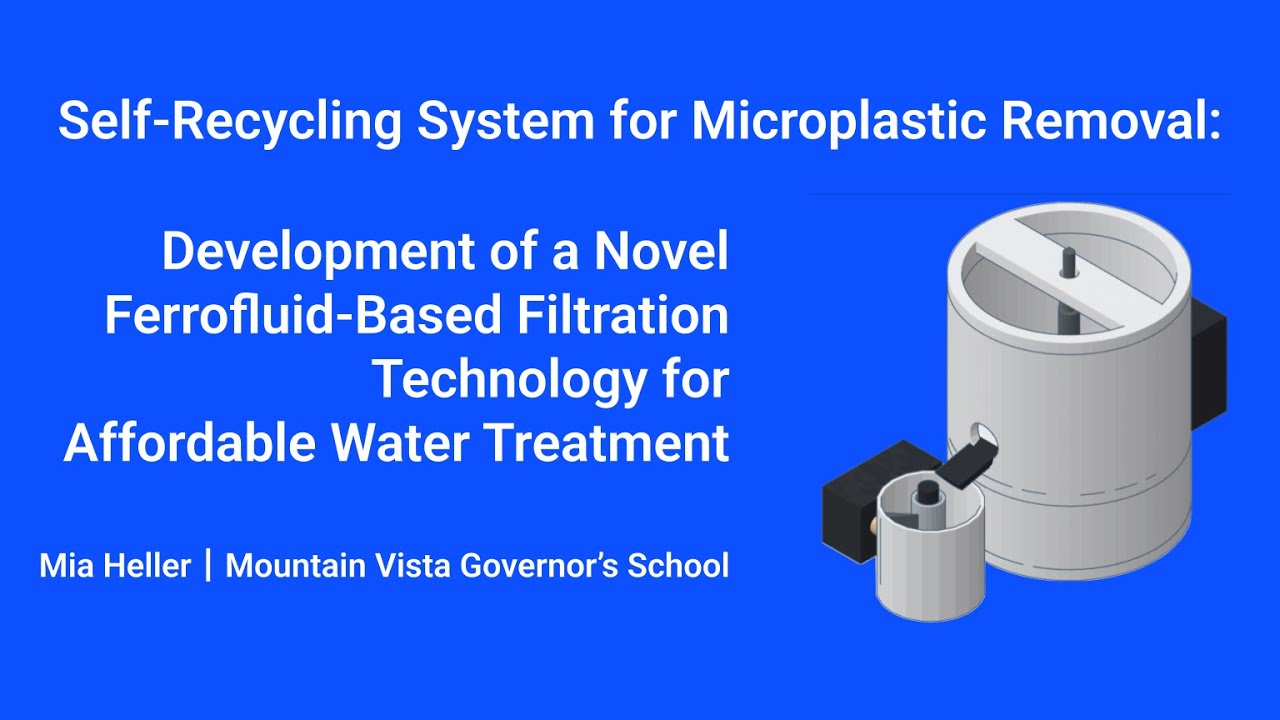
The design goal: remove microplastics without disposable membranes
Mia Heller began from a practical household problem. Public reporting describes concerns about PFAS and microplastic contamination in her area and her family's experience maintaining an advanced home filtration system. The replacement membranes required ongoing attention and expense. Heller's response was to investigate whether microplastics could be separated from water using magnetic chemistry instead of a disposable membrane.
The result was a compact, self-recycling ferrofluid system. At the 2025 Regeneron International Science and Engineering Fair (ISEF), the project was entered in the Environmental Engineering category as ENEV053. The official ISEF finalist directory listed Heller as a 17-year-old junior from Mountain Vista Governor's School. Smithsonian's March 2026 profile described her as 18, which is consistent with the passage of time rather than a contradiction.
What is ferrofluid?
A ferrofluid is a liquid containing extremely small magnetic particles suspended in a carrier fluid. The nanoparticles are stabilized so that they remain dispersed rather than rapidly settling out. When a magnetic field is applied, the liquid can be moved or concentrated. Ferrofluids are used in specialized seals, loudspeakers, sensors and research systems; Heller applied the concept to water treatment.
Her idea depends on the ferrofluid interacting preferentially with microplastic particles and then using a magnetic field to pull the ferrofluid-and-plastic fraction away from the water. The major engineering challenge is not simply attracting the contaminated ferrofluid once: the system also needs to recover and reuse the ferrofluid so that it does not become a costly consumable or a new pollutant.
The three-module prototype
Smithsonian describes Heller's later prototype as roughly the size of a standard bag of flour and composed of three modules:
Heller went through roughly five iterations to coordinate ferrofluid flow, magnetic separation and fluid recovery. One difficulty was managing the ferrofluid's higher viscosity and preventing flow paths from clogging or interfering with one another.
- Water chamber: approximately one litre, containing the contaminated water.
- Ferrofluid reservoir: stores the reusable magnetic oil-based fluid.
- Separation/recovery module: a smaller unit in which magnetic separation removes microplastics and the ferrofluid is recovered into a closed loop.
How she measured performance
A particularly strong feature of the project is that Heller did not rely only on visual inspection. She developed a custom turbidity sensor to estimate the amount of suspended material and calculate a weight-based microplastic removal result. According to the test results reported by Smithsonian:
Those figures are useful for a student prototype, but they are still project-level results. A turbidity-based method can help, yet a commercial or peer-reviewed evaluation would ideally use independent particle counting and polymer identification methods, such as microscopy combined with Raman or FTIR spectroscopy, to determine exactly which sizes and polymer types were removed and whether any ferrofluid residue remained in the treated water.
- Microplastics removed: 95.52%
- Ferrofluid recovered/recycled: 87.15%
- Batch size described in profile: About 1 litre in stand-alone operation
Awards and official verification
Heller was a finalist at Regeneron ISEF 2025. The Society for Science's official Special Awards announcement lists ENEV053 and Mia Heller and records recognition from the Patent and Trademark Office Society. Smithsonian reports that the special award was worth US$500.
The official ISEF finalist programme is especially valuable because it confirms the project title, category and Heller's age/grade at the competition. It also helps separate the 2025 invention milestone from the wave of media coverage that followed in 2026.
What is genuinely new here?
Magnetic separation is not new, and ferrofluids have been investigated in other cleanup applications. Heller's student-engineering contribution is the integration of microplastic capture, magnetic separation and ferrofluid recovery into a small, self-recycling water-treatment prototype intended to reduce membrane replacement. The closed-loop part matters: a system that used fresh ferrofluid for every batch would likely be too expensive and could create a secondary waste stream.
Limits and unanswered questions
- Independent replication: Heller herself has said she wants professional confirmation of her home/lab results.
- Ferrofluid residue: treated water must be tested to ensure magnetic nanoparticles or carrier oil are not left behind.
- Particle-size range: the public percentage does not by itself show performance for the smallest microplastics or nanoplastics.
- Polymer diversity: polyethylene, polypropylene, PET, polystyrene and other polymers may interact differently with the ferrofluid.
- Disposal: the separated plastic-rich waste must ultimately be destroyed, recycled or securely contained.
- Ferrofluid economics: Heller noted that ferrofluid is currently expensive at large scale, which is why she sees the near-term application as a household/under-sink system rather than a municipal plant.
- Flow rate: a one-litre batch prototype must eventually demonstrate practical continuous throughput.
Why the project matters
Many student environmental inventions focus on a single cleanup step. Heller's project is more systems-oriented: it recognizes that the capture material itself has to be recovered and reused. That is an engineering mindset closer to commercial water treatment, where operating cost, maintenance and secondary waste often determine whether a clever laboratory mechanism is viable.
The 95.52% result should not be read as a regulatory certification, but it does make the prototype worth further independent study. If a closed-loop ferrofluid system can remove a broad spectrum of microplastics without releasing nanoparticles or oil, it could offer a membrane-free alternative for selected point-of-use applications.
Evidence note
Evidence note: The 95.52% removal and 87.15% ferrofluid-recovery values are reported from Heller's prototype testing. They are not the same as independent certification of potable-water safety or long-term filter performance.
Sources
- Smithsonian Magazine , detailed March 2026 technical profile
Reported technical profile with prototype testing details. (LINK_ONLY)
- Society for Science , official Regeneron ISEF 2025 Special Awards
Official competition record, award listing, or finalist documentation. (LINK_ONLY)
- Regeneron ISEF 2025 finalist programme , ENEV053, age 17 at competition
Official competition record, award listing, or finalist documentation. (LINK_ONLY)
- ISEF project listing (ENEV053)
Official competition record, award listing, or finalist documentation. (LINK_ONLY)
- Video , Self-Recycling System for Microplastic Removal (ISEF 2025)
Video record of the project or demonstration. (LINK_ONLY)
- People , 2026 profile
Reported profile or project reference supplied with the research draft. (LINK_ONLY)