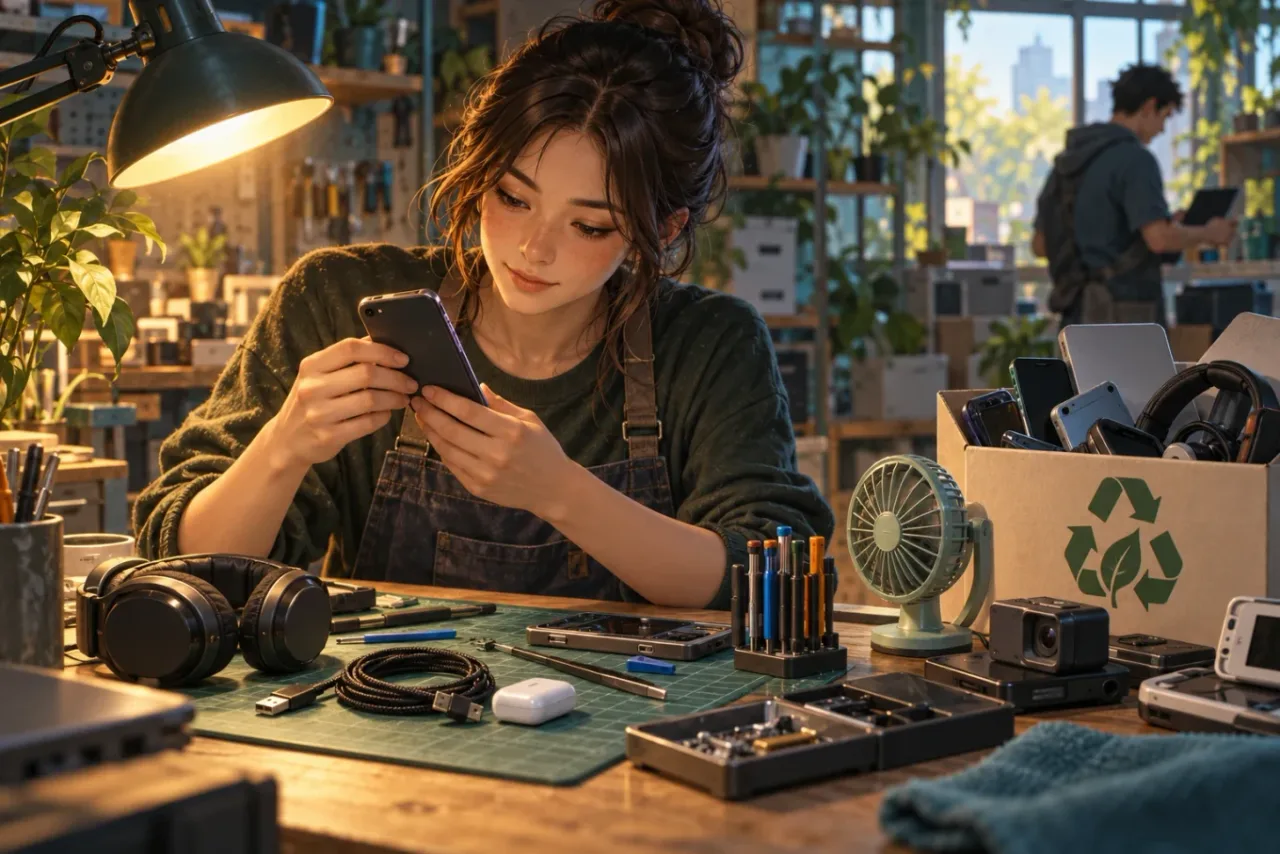
The cable that no longer fits anything. The wireless earbud that stopped charging. The toy with a broken light. Small electronics are easy to forget because each item seems too minor to deserve a special trip. International E-Waste Day on 14 October 2026 puts those objects at the centre of the conversation.
For its ninth edition, the WEEE Forum is focusing on “Fast Tech”: inexpensive electrical products that are easily bought and quickly set aside. The official campaign includes products such as charging cables, small fans, earphones and electronic toys. Its central message is to recognise electrical waste and return it through appropriate collection systems.
Small objects belong to a much larger waste stream
The Global E-waste Monitor 2024, prepared by ITU and UNITAR, reports that the world generated 62 million tonnes of e-waste in 2022. Only 22.3% of that mass was documented as formally collected and recycled in an environmentally sound manner. Those are global figures for 2022, not a measurement of Bulgaria in 2026.
The word “documented” matters. The statistic describes a tracked collection and recycling system. It does not justify assuming that everything outside that percentage followed the same route. For a household, the practical lesson is simpler: know who receives your unwanted equipment and what service they actually provide.
Begin with one drawer, not a shopping list
Set aside a short session before 14 October to identify devices you no longer use. Work through one cupboard or desk drawer and write down what is there. Keep accessories with their matching devices where possible. A power supply without a label and a device without a charger can both become harder to assess.
Give each item a next step: keep using it, seek a repair assessment, offer it to a named person or organisation that wants it, or arrange an appropriate waste handover. Do not describe an untested device as working. If you offer something for reuse, state the fault, missing parts and known condition plainly.
Try to finish one handover rather than creating a new box labelled “deal with later”. The date is useful as a deadline for a decision, even if the collection service operates on a different day.
Confirm the receiving route before leaving home
For readers in Bulgaria, start with the municipality's current waste information or the retailer's published take-back service. Check the exact item category, collection address, opening hours and any booking requirement. A service that accepts small devices may have different arrangements for screens, lamps or large appliances.
Ask separately about devices with built-in batteries and anything visibly damaged. Do not assume that every battery box can accept a complete electronic product. Follow the receiving operator's instructions for preparation and transport.
The US Environmental Protection Agency's battery guidance explains the fire risk when lithium-ion batteries are damaged or crushed in ordinary waste collection. It advises keeping these batteries and devices containing them out of household rubbish and mixed recycling, and obtaining specific instructions for damaged batteries. Its US collection links are not a directory of Bulgarian services.
Protect the information stored on a device
Before passing on a phone, tablet or computer, use the manufacturer's current transfer or disposal instructions. Back up anything you need, address linked accounts and activation locks, and remove personal storage or cards where the instructions require it. The correct sequence depends on the product.
If a device will not turn on, tell the receiving service that its data has not been erased. Agree how data-bearing equipment will be handled before handing it over. A collection receipt records a transfer; it is not automatically evidence of data destruction.
Make a community activity useful from start to finish
A neighbourhood group can help by sharing a verified collection route or arranging a joint trip. If you want to host a collection point, first agree acceptance, storage, supervision and pickup with an appropriate operator. Publish the accepted categories and exclusions alongside the invitation.
Afterwards, distinguish devices sent for reuse, items awaiting assessment and waste accepted for treatment. Report a weight only if it was actually measured, and avoid calling everything “recycled” at the moment of collection.
For the next purchase, ask a question prompted by this drawer audit: which overlooked object could have stayed useful with a replaceable part, a clearer label or a repair? International E-Waste Day can close an existing waste loop and improve the next buying decision.
Campaign details and sources checked on 3 October 2026. No local collection event or universal retailer acceptance policy is assumed.
 Garbamons